Saturday, July 25, 2015

Thursday, July 23 - Stage 4 - 28 miles, Day 7 - Border Crossings

Today, Sally was reminiscing about her solo trip to Europe at age 19. These thoughts from the past surfaced as we started crossing country borders like jumping hop scotch lines. Back in the 70's, each time a border was crossed, your passport was inspected and the money in your pocket was worthless until exchanged for the currency of the country you were entering. Today, we have to closely inspect a map to figure where the border was, as we probably crossed it without notice. Except for Switzerland, who held out from joining the European Union, all currency is the Euro and all borders are open and transparent. With the Swiss Franc and the Euro at nearly par for value, ($1.04 & $1.10 respective to the U.S. Dollar) most places in Switzerland accept the Euro, although they prefer the Franc. 

We started the day in Kreissen, Switzerland, heading north, with the Rhine just to our right. Somewhere, just past Au, Switzerland on the Rhine delta where it enters the Bodensee, a huge lake (sometimes called Lake Constance) we crossed into Austria. We cycled east along the beautiful waterfront park area of Bregenz, Austria, then followed the lakeshore as it turned north. Somewhere on the outskirts of Bregenz we passed into Germany. 

Although the borders were transparent, we could tell we had left Switzerland. Everything was suddenly dirtier and grimier, and the people were not as friendly. I know this is a subjective observation and comment, but we did not realize we had crossed a border, yet we felt something had changed. Weeds now sprouted in the cracks of the roads and curbs.  The chain link fences along the railroad were full of weeds. The area between the railroad ties were weedy. People we passed on the path responded to our "Gooten Morgan" with a frown or no response at all. The clerks and workers in the stores were sour and dismissive instead of smily and helpful. It was weird. Of course, not everyone was like this, but the percentages swung drastically higher with our new territory. 

Riding around the Bodensee is the most popular bike route in Europe. Once we started to circle this huge lake the number of cyclists we encountered went way up. There is a designated bike trail for many parts, and quiet back roads for some. Regardless, not a moment went by that we did not see another cyclist and usually we saw 10 or 20 other cyclists. 

Our goal was a campground near the medieval island town of Lindau, 10 miles up the shore from Bregenz. The cycling path was delightful, often right on the shore of the lake, sometimes through orchards just inland from the shore. When we reached the campground a few miles before Lindau, we felt it was too early to stop, so we scanned the map and found another campground 5 miles past Lindau, in Wasserburg. 

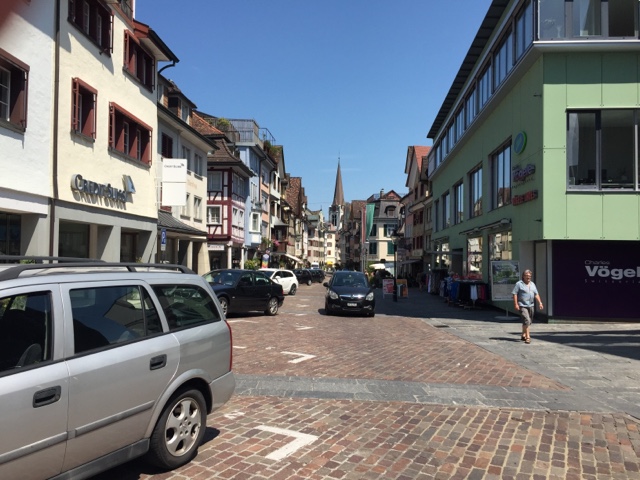
We reached Lindau about noon and were surprised to find it a very popular tourist town. We explored its narrow streets and shops on our bikes, dodging the horde of people, and visited its ancient harbor on the lake. The town prospered as a trading port, located between Nuremberg and Italy. 
We entered the town on a bridge on the south end and left via a causeway for bikes and trains on the north end.
More delightful cycling brought us to Wasserburg and our campground, about 2:00 pm. Most businesses close between 1:00 pm and 3:00 pm for the mid day meal. We took the opportunity to ride the 0.5 kilometers to town and enjoy a pastry at a sidewalk bakery and plan our next moves. 
We registered to camp with a stern German woman who softened and became very friendly the more we talked. With the tent pitched near the restroom in the shade, we rode out to the peninsula that was an island in the old days (hence the name "Wasserburg" - "water city") visited the church and settled into a restaurant on the harbor for a beer and a Coke. We spent an hour enjoying the sea breeze (remember, this lake is huge!) and passerbys before cycling back to our site for dinner of a salad. 

Sally spotted a VW Westfalia and went to talk to the owners. They were a retired Swiss couple in their 70's that summer in Greece for 9 months and return to Switzerland each winter for three month of skiing. Both have a keen interest in medieval churches and travel to sites in Greece and elsewhere to study them. The conversation turned to American politics, in particular how wonderful they thought President Obama. They could not understand what was wrong with the American people who disliked him. They also were as disgusted with Donald Trump as we were. They were scared of the Republicans because such a bad man (their words) as Trump was leading the polls for the Republican party.

It has been fascinating, the attention everyone we have met, pays to American politics. They follow it closely, perhaps more than most Americans, and feel the impact of America's decisions in their own lives.  

After dinner, we showered and read a little about tomorrow's distances and objectives. We only have a single border crossing tomorrow, when we take the ferry across the Bodensee from Friedrichhausen (Germany) to Romanshorn (Switzerland) to connect with our good friend Gallus near St. Gallen.  


Friday, July 24, 2015

Wednesday, July 22 - Day 6 - Stage 3 - Liechtenstein to Kreissen - 36 Miles - End of the Alps

When planning this trip, I often used Google Earth to fly over the route. Doing this gave me an idea of the terrain and topography we would encounter. Of course, I always started at Oberalppass because the mountains are so dynamic there. The relief shown with Google Earth in that region is amazing. High in the alps. Ragged peaks, impossibly steep slopes. Glaciers. By the time I had made my way down to Bodensee, the third largest lake in Europe, about 100 miles down the Rhine, the terrain near the Rhine was so flat, the alps being left behind, that I kind of lost interest in the details from that point on. I would fly over the remainder of the ride all the way to Rotterdam, but the details escaped me because the dynamic landscape was no longer there. Today, we did the real thing. As the Rhine flood plain widened, the high Alps moved farther away and we transitioned from ragged peaks and tumbling water to the more stately, smooth flowing water in a large river. I knew I would miss the alpine region, that it would pass too quickly, and it did. But, if Rotterdam is your goal, you can't hang too long in the alps. 

90° is forecast for today. We were up, dressed, packed and on our bikes by 6:00 am. The first mile from the campground was a quick, steep downhill plunge off the side of the Rhine valley back down to the river basin. A few minutes of pedaling along the highway and we were in the capital of Liechtenstein. The prince lives in the castle above the city, but from the actual downtown streets it is hard to see because it is straight above, on top of a several hundred foot cliff. Not until we cycled toward the Rhine and out of the downtown core could we see it well. Position is everything in real estate. Whoever built the castle got the overlook the valley and peasants aspect correct, but in their desire to dominate by position they forgot to consider the sun. 
The river runs north here. They put the castle high on the eastern shore, tucked up against the mountain on a cliff. The sun does not get to that piece of real east are until at least ten in the summer and who knows when in the winter.  Cold and dank.  I'll bet the sunsets are nice, but I'll take a southern exposure any day. 
Our route took us north along the dike on the east side of the river that constrains the Rhine to a bicycle only bridge that deposited us in Buchs. By crossing the river, we left Liechtenstein and entered Switzerland again. We were back in cell service again.  Before we left home I had downloaded all the maps necessary to ride the entire route into my phone just in case we were without service at times, so navigation was not a problem while in Liechtenstein, but communication and information on the places we were heading to was. With cell service back with the crossing of the border we could look up camping, B&Bs, the weather forecast, history and info on the towns we would be visiting, but most important, we could contact Gallus Muenter, our friend in nearby St. Galen and arrange a time and place to meet on Friday. 

We met Gallus back I the summer of 2008 in Yosemite. He and I had climbed Half Dome (via the cable) together and had spent 3 days together. We visited him in St. Galen when we had come to Europe in 2009. We were anxious to get together with him again on this visit and catchup on what had transpired over the past six years. 

We found a very well tree shaded outdoor restaurant that was not open yet and availed ourselves of their tables and chairs to sit down for an early lunch and info session. We plotted our time to the St. Galen area and our route along the north or German side of the Bodensee, a huge lake bordered by Switzerland on the south, Germany on the north and Austria for a small portion where the Rhine enters the lake. Once we knew our timeline we called Gallus to arrange our meeting. Using Skype, we got through and arranged to have him pick us up at the ferry dock in Konstanz on the Swiss side of the lake. We would take the ferry from Meersburg over, after having ridden the length of the German side of the lake. 

We continued to ride toward Altstatten, our destination for the day, passing along one lane paved roads through the middle of farm lands growing corn, grain, potatoes, carrots and grazing dairy cows. Occasionally, we would dodge tractors and cars, for although these seem like bike paths we are on, they are working roads. 

We had not established exactly where we were staying tonight. We had hoped for a B&B once we got near Altstatten or a farm with a sign up saying, "schlafen im stroh", meaning "sleeping in the hay", referring to barn space available for a night's rest. We began making inquiries of people we met along the route, usually in very broken English, but soon we learned there was a campground in Kreissen, about 4 miles from Altstatten, adjacent to the Rhine. One women, the owner of a restaurant not yet open for the day googled the location for us on her phone. I mapped the address on mine and we were set for the night. 

This is the huge advantage of travel on bikes. We are with the people, not encased in glass and steel. We are moving at their pace, not whisking by, propelled by gasoline. We stop very often, perhaps every 5 minutes, to take a picture, examine a building, drink from a fountain in a town square, talk to someone or buy a pastry (so much for losing weight with all this exercise!). This pace of travel is wonderful. We don't feel the need to go to the "sites", because we are seeing and experiencing so many during our travel time. Occasionally, an especially historic or important landmark merits pulling us off our path to visit, but mostly we are just enjoying the everyday experiences of the area we are traversing. 

We debated heading directly to Kreissen and foregoing Altstatten as it was now a 3 mile side trip. But we were so close we decided to go to it first, visit its historic downtown area, then ride the four miles to the campground in Kreissen. It was now 90°. We reached Altstatten and found a sidewalk restaurant for a beer and a coke in the shade. After half an hour's rest we headed for Krissen. We stopped quite a few times in the shade to cool off as we could, but finally reach the campground about 3:00 pm. Sally was as red as a beet by now, and severely overheated. The woman running the campground looked at her with alarm and suggested a swim in the lake adjoining the property. Sally was inclined to agree and was in the lake as I finished setting up our tent in their lawn. 

"Camping" continues to be more expensive than we thought it would be, averaging about $25-30 for a night, but within our budget. At our current pace, we could write the book, "Europe on $50 a Day", although we do exceed that number occasionally. 

We spent an hour in the lake, a 100 by 200 meter pool of water trapped beside the dike holding I the Rhine and fed by groundwater. As the Rhine rises and falls, so does their lake. It has no inlet nor outlet, but the water is clean. Very similar to the areangement that creates Wallace Pond in Toledo. 

Thunderstorms were forecast, and the skies did not disappoint. The wind howled and soon the sky was flashing and booming with rain pelting down. We sat under their snack bar roof and enjoyed the show. The owner came and talked with us for an hour. She has two three year two girls and a 1 year old boy, plays the piano, and travels to Nrw York occasionally to meet s girl friend and attend concerts and shows. She took our email and invited us to visit her when we return to Switzerland I the future. 

With the rain nearly finished we crawled under our quilt in our snug tent and called it a day. 


Thursday, July 23, 2015

Tuesday, July 21 - Stage 3 - 28 miles, Day 5 - Heidiland

Shirley Temple made the book famous in 1937 when she played the roll of the Swiss girl, Heidi, sent off to live with her grumpy grandfather high in the Swiss alps. Although Heidi was only a figment of the imagination of the author Johanna Spyri, she used real locations in the book, in particular, Maienfeld. Inspired entrepreneurs seized on the public's love of the story and have erected "Heidiland" above the town of Maienfeld, Switzerland. In fact, the whole region for five miles on either side of the town is called "Heidiland". Our Eurovelo Route 15 goes right through it. Sally remembers the book from her youth, so naturally, she was excited to see the area. Curiosity drove my interest as well. 

We left our campsite in Chur at 6:30 am, sneaking out before anyone else was awake. We quickly got back on our route and enjoyed level and slightly downhill peddling for the first few hours, leaving Chur behind. 

I have to admit that I was hungry all morning in spite of eating a breakfast of bread, cheese and fruit. I was constantly raiding the food stores in my pack, eating bananas, chocolate bars and more bread and cheese to satiate my hunger. It was like PCT grad hiker hunger.  In one small town we passed, we happened upon a grocery store. I found a wonderful walnut pastry, bananas and a bag of chips. I consumed these just outside the door of the store. Here is the difference between the PCT and this biking trip. On the PCT I would just have to be hungry, because I'd I ate more food on that day there would be none for the next, i.e., no stores. On this trip we pass stores daily and I can buy what I "need".  How this all equates with weight gain or loss waits to be seen. 

We climbed up the side of the Rhine valley, entering Heidiland. It is spectacular scenery. The road undulates across the hillside. Passing through fields of corns, carrots, grass and vineyards. When we reached  Maienfeld we could continue the traverse or turn right and climb towards the hotel, restaurant and other artifacts of Heidiland. We checked the web and our guidebook, but none gave the distance up to the grounds. It was too steep for Sally to ride so I began pushing both bikes up the hill with dally following. After about half a mile we again checked for distance on the web. This time we were more successful. Another half mile to go. The temperature was in the mid-eighties by this time, but the urge to see all things Heidi spurred us on. 

I reached the parking lot to the restaurant first, dripping in sweat. I could hear Sally talking to someone below on the road. Soon, a camper van, not too different than our VW van came up the hill and pulled next to me. The owner, Fritz, jumped out and handed me a glass of water. These kind Austrians had taken pity on the guy pushing two bikes and the overheated redhead walking up the steep sunny hill and had stopped to give up water. 

We laughed and talked until Sally's bright red face began to return to normal. Fritz spoke no English, Lillian quite well, but we managed fine. 

After they drive off, we locked our bikes in the lot and walked the five minutes to the Heidi Village to see the Heidi swag in the gift shop and the myriad Bronze statues of goats, kids and old men, along with real goats, a fountain and the head of the trail that leads to the Heidi Cabin an hour and a half walk up the mountain. 

We decided to forgo the walk up to the cabin perched on the mountainside. A bus load of Japanese tourist had arrived. We dodge in and out of the crowd taking photos before returning to our bikes. We sat to eat lunch near our bikes in a patch of shade. A young family of four, mom, dad and two cute girls, ages 6 and 4 sat next to us in the shade, each lacing on their boots for the home to the Heidi cabin. The little girls were so cute in their excitement to see Heidi's cabin!

The ride down was a brake squeezing breeze and soon we were back on route, gently traversing downward thru the remainder of Heidiland until we reached the Rhine, crossed it, and began cycling down a dike on its west side. Periodically we would pass what looked like concrete gun emplacements. A little exploring proved that's what they were. They were now welded shut, but the design showed at one point they had artillery of some sort able to shoot both up and down the length of the Rhine. 

We crossed a cycling bridge across the Rhine, waited for a farmer to get his cows across the road, then cycled into Liechtenstein, stopping for groceries, before continuing on to our campground, up on the side of the hill.  Still in the high 80° we sweated up to it, set up camp and took showers. Our neighbors, Gabriel and Lillian from Holland, were talkative and fun. They invited us for tea. He is a warehouse manager, she teaches middle school STEM. 

A swim, a salad, and we were ready for bed. My internet coverage from T-Mobile does not include Liechtenstein. Information wise, we would have been in the dark, but the campground fee includes one hour of Internet. We used it to plot our next day's course and accommodations. 


Wednesday, July 22, 2015

Monday, July 20 - day 4 - stage 3 - Zero Day - White Noise

The campgrounds we have been staying in are busy. It is the high season and Europeans are on holiday. Of course, our second night out we were by ourselves, but the two nights we have spent in campgrounds have seen us surrounded by tents, couples, kids, cyclists, hikers and car campers. If I were camping in the U.S. this way, I would not enjoy it. But here, everyone is speaking a language other than English, so all their conversation are just "white noise". If it were in English, my mind would pick up on the conversation threads and it would interrupt my thoughts. But since I have no comprehension of what they are saying, the sounds just blur into background noise, like a gurgling brook or pounding surf and it is soothing and melodic. Just ambient noise. 

We have enjoyed meeting the people camping near us. They all graciously speak English for us mono language Americans. Knowing only one language makes us feel embarrassed. It seems an insult to require everyone else to communicate with us on our terms. However, no one we have met feels that way towards us and we have enjoyed their company. 

It was a lazy day today, by design. We rode into the city of Chur, bought groceries, toured the historic old town (very cool!), and had pastries (that is a daily occurrence!). Back at the campground we donned our swimsuits and headed to the gigantic, outdoor, public pool adjacent to the campground. The pool is the size of about three Olympic pools combined, plus there are a few water slides and acres of well tended lawns to lay on. It is, obviously, very popular, as it was well attended, but not crowded. 

A salad for dinner from our grocery store purchases was excellent. The wind was up all afternoon, and the thunder clouds gathered, rumbled and spit a little rain after dark, but not enough to wet the ground. 

We worked on the details of where we might stay tomorrow night and decided to spend the night in a campground in Liechtenstein, about 25 miles away. We were hoping for cooler weather, but the forecast is for 90° tomorrow, 2 degrees warmer than today.  


Sunday, July 19 - Stage 2 - 28 miles, Day 3 - Wow!


It's the details that make the difference, don't you think? For example, a house is four walls and a roof, with maybe a few doors and windows thrown in for access and light. But the trim, the siding, the paint, the fit of each part in relationship to its adjacent part, the architectural style, in short, all the fine points, the details, are what make the difference between a wooden box to live in and a house. 

Switzerland is obsessed with the details. Everything we see or touch is exquisitely crafted in every detail. The homes are crafted, not just built. There is nothing sitting outside the homes to clutter them. The wood in the woodpiles are artistically arranged, sometimes with geometric designs. There is no litter, no trash. No weeds grow between the curbs and asphalt of the roads. The restrooms at the campgrounds are tiled, spotless, with solid latches on the doors and meticulously maintained. Even the train right-of-ways are weed free and spotless. We ride our bikes through little villages about every 2-3 miles. Each has at least one fountain in the town square, flowing with water for drinking and artistically designed. What a beautiful country. 

Today we hoped to make it to Chur. Our guidebook says it is the toughest section of the whole ride to Rotterdam, with over 300m of vertical gain and lots of ups and downs. We are nearly four miles off our route, although it is mostly downhill to regain it. Last night, feeling tired at the end of the day, Sally contemplated taking the bus through this section to avoid the uphill. This morning, she decided to try it, and if it became too much, she would get on the bus to complete the day.  The forecast is for very hot weather again, another reason she is contemplating the bus. To avoid the heat, we rose at 5:15 am today and we're on our bikes by 6:30 am. Sometime between last night and this morning, I knocked my mirror off my helmet. I searched this morning, but in the tall grass, could not locate it. I'll ride without one from this point on. 

The ride down to Ilanz was a breeze. Last night's uphill is this morning's downhill. From Ilanz, we gently climb for the next couple hours, rising far above the Rhine as it flows through a gorge. In a few spots the road gets too steep for Sally and we push our bikes up the hills. 

It is still very early Sunday morning and there is no traffic, especially on this small country road. The temperature is still cool, but it is forecast to get into the low 90s for a high. 

Once we reach the top of the climb we rode a very steep descent through 6 switchback to the bottom of a tributary gorge to the Rhine, then another climb, this time through three tunnels. Finally, we have a long descent into the town of Bonaduz. We are thirsty, but it is Sunday and all of Switzerland is closed, including restaurants. We have a couple liters of water. We mix up a quart of flavored drink to quench our thirst. 

Just outside of Bonaduz the trail drops right next to the Rhine. Here we stop for lunch of hard boiled eggs, bread and cheese and a nectarine. It is amazing how many people pass by on the trail as we eat. Cycling is very popular in Switzerland. 

There are actually two forks to the Rhine this far up. We have been following the main fork, but at the town of Reichenau the two forks meet. The one we are following is laden with silt and grayish in color. The other fork is turquoise and clear. When they join the two waters are very distinct and take several hundred yards of distance to completely mix.  We observe this phenomenon from the bridge across "our" fork of the Rhine in Reichenau. 

It is now afternoon and it is hot!  To make matters worse, the route again goes uphill, this time steeply into the town of Tamin. It is not a long hill, but steep enough that Sally cannot ride it. I push our bikes up the hill while she follows behind. From this point on the route is gentle downhill to the town of Chur, our destination for the night. 

We roll into the campground at 3:00 pm, register and find a campsite in the "pitch" area. Sally lays down for a nap and I hop on my bike, in search of an open store to score some dinner and lunch food. It is about a mile to downtown Chur. Riding through the city I find nothing open. Finally, I find a gas station that sells the usual gas station foods and buy a few items for dinner. 

When I return Sally is awake and has tidied up the tent and campsite. The afternoon wind is roaring up valley. All our damp articles packed in the dewy morning, dry nearly instantaneously. After a dinner of chicken bullion, noodle and carrots soup with cookies and donuts for desert we visited with the Ari and Stanee,  

Ari and Stanee from Rotterdam. They are cycling from Rotterdam to St. Moritz to meet with their son, his wife and their grand baby. They invited us to share a bottle of wine and discuss what our route ahead looks like as they had just completed it. A thunderstorm let loose torrential rain just as we were about to sit down on the lawn of the campground. We moved to the entrance foyer of the men's room, found two chairs and discussed biking, Netherlands and US politics while campers filed past to shower or use the toilet. Obviously, they are very flexible. They gave us their address and phone number in Rotterdam and invited us to stay with them when we reach their home town. 

Tomorrow we will stay put, letting our bodies catch up to the labor they have been performing. The big picture is a bike trip through Europe. But, it is the details, suchnas meeting new people, that make the difference. 


Monday, July 20, 2015

Saturday, July 18 -Stage 1, Day 2 - 24 Miles - Learning from the Learning Curve

"Fool me once, shame on you. Fool me twice, shame on me."

This old proverb implies that the first time a mistake is made, it's not necessarily your fault, that some outside influence has acted. However, if you make the same mistake again, you are now responsible for your actions. Today, we tried to apply what we learned yesterday to avoid getting caught by high camping fees and rain. In other words, not be fooled twice. 

The rain of last night had the tent covered with beads of water. The inside was also covered in water, condensation accumulated during the night. I carefully exited the tent, avoiding the walls and the water that they deposited with each touch, and headed for the showers. Sally was still sleeping. The sky was crystal clear and the sun was beginning to warm and dry the landscape. 

We are navigating, researching and communicating via iPhone. Next to our credit card and passport, it is our most important possession. Keeping it charged and in working order requires constant vigilance. I am carrying two auxiliary batteries to keep it fed, one will charge it 2 1/2 times, the other six times. Keeping the phone charged is easy, finding power to keep the batteries charged is the challenge. The batteries have an advantage.  When in a public place such as a campground, I feel very uneasy leaving the iPhone plugged into an outlet in the restroom, whereas leaving a battery sitting on a random shelf is far less intimidating. Last night, I left my battery sitting on top of the dehumidifier in the community "drying room" to charge, and found it safe, sound and charged when I made my nightly trip to the john. 

Hard boiled eggs and artisan bread with cheese for breakfast, squeegee the tent to remove 95% of the water, a quick packing job and we were on the road by 9:30 am. 

The climb back to the highway was a poor prospect for the first thing in the morning. The lady at registration had pointed out we could ride a dirt road out the bottom of the campground and pick up the bike trail in a kilometer or two. We took this option. 

Our guidebook gave two options from Disentis, take a series of back country roads and mountain bike paths or follow the highway. With our decision to leave the campground on the dirt road rather than the killer climb back to the highway, we had relegated ourselves to the backroads. 

Within 20 minutes we knew this was a mistake. The route occasionally hit roads, but most of the time it was a steep, double track mountain bike path, climbing and descending. Too much for our second day out. Consulting the GPS, we found an escape route up to the highway, but not before Sally lacerated her calf on the chainwheel of her bike during a hurried dismount. 

Once on the highway, things went much smoother. As it was Saturday, the traffic in this recreation oriented area of Switzerland, was heavy. But there were many bikes on the road and the drivers were respectful and gave us plenty of room. 

The Swiss countryside was magnificent. How is it that every blade of grass is trimmed, right to the margins of the highways? The view, taken as a whole, is like looking at a massive golf course dotted with barns, picturesque homes and rail lines. 

We arrived in Ilanz about 2:00 pm after many, many frequent stops to see sights, take in the views and enjoy the advantage of riding a bike rather than speeding along in a metal and glass enclosure, a car. 

Determined to find cheaper accommodations for the night we consulted Yelp, our camping app, Zimmers, AirB&B and other resources, all to no avail. We asked people we met along the road where an inexpensive place to camp or stay was, again to no end. 

Ilanz is a popular kayaking site, with weekend adventurers dotting the rivers in their brightly colored boats. Feeling dejected, and tired, we rode past three young men loading their kayaks onto their car. I stopped to ask if they knew of an inexpensive place to camp. They were full of fun, but warned us that Switzerland was strict about squatting on random properties without permission. After a few minutes of broken English/German discussion one of them brightened and said "Pitasch Mühle". 

He described an old man in a old roadhouse/restaurant squeezed between a road and the river who let people camp behind his house down next to the river, for free. He and his friends debated on the distance, but settled on between 5 and 7 kilometers up the highway toward Vars. 
Sally was waiting up on the road above the parking lot for the results of my inquiry. I described what I had learned. It was not a certainty, but free camping after our $45.00 night was a strong incentive. Sally was quite tired, but agreed to try it as long as it was gentle uphill or level. She was worried that if it did not pan out, she wouldn't have the strength to pedal back to town for a hotel. I scanned Apple maps for the likely location of "Pitasch Mühle" from the description I had received. The app said 3.7 miles. 

At 3:15 pm we set out. A short, steep hill out of town had Sally off her bike and walking up. From there the road was forgiving, ever so slightly uphill or level for the first two miles. The grade increased for the last 1.7 miles, and just as described, the roadside inn came into view around the corner. 

After parking our bikes, we walked in. A very happy, laughing and smiling woman greeted us in German. She knew no English. We asked about camping, but she did not understand. I showed her a picture of our tent in last night's camping spot and she brightened up and said, "Yah, sure!" and walked us out the door and around the house to point to the lower yard below. We asked how much and she understood enough to make a frowning face and say "Nin!" 
We took a seat at one of the outside table and she served Sally a beer and me a Coke. We rested for an hour. During this time a man drove up in a car, parked, and went inside only to return a few minutes later with a cup of coffee and a crossword puzzle. He seated himself at a distant table and began working his puzzle. 
We took a picture of the place, then Sally asked for a picture of him. He was as happy and boisterous as the woman and verbally sparred with us, although neither of us understood a word. We went inside to pay for our drinks. We found the woman crocheting a beautiful table runner, extremely intricate. We paid, tipped her and asked if we could take her picture with Sally, on the front porch. She consented, but first, giggling, ran over and threw her arms around the man, her husband, and posed for a photo, then returned for the picture in front of the front door. 
We retired to the back yard, a field of unmowed grass with a nice tree and pitched the tent. I went to the river, stripped and bathed in the river, shielded from the house and road by thick trees. Sally took a rest in the tent, then did the same. About 8:00 pm the thunder began, with rain by 9:30 pm. I always enjoy the thunder, but tonight I fell asleep in the midst of the storm. 

Score us plus two for the day. No shame on us for repeated mistakes. We were camped before the rain started. We found camping for free. But, we must take one away for pushing Sally to the point of exhaustion. She did well, and recovered well, but the last climb was pushing her limits. 


Friday, July 17 -Stage 1, 19 miles - The Learning Curve

Think of the things you do on a regular basis. They become repetitively and because of that we build routines around them. We establish what seems to be the most efficient way to do a job, refined by repetition, and then we mindlessly go about our business. Often, we end up doing nothing but routine work. When our life becomes nothing but routine, with no uncertainty to spice it up, we get restless and uneasy. We feel like something is "missing". We start looking for something to break the routine. An adventure. Something as simple as a spontaneous shopping trip or as complex as a bike trip in Europe and anything in between. 
These routines, when not overbearing and monotonous, are comforting. They give us a sense of place, of familiarity. We always put something in the same spot so it's easy to find. We get up at the same time each day, ride the same bus, have a Pepsi at the same hamburger stand, play cards on the same night of the week. If something breaks our routines, we feel uneasy. 
Leaving for Europe, I put my trusty wallet away in my chest of drawers and strapped a money belt around my waist. I did this a day or two before leaving in hopes I could get used to that empty spot over my right rear cheek that always feels the weight and warmth of my wallet. Each time I sat in a car, I noticed the lack of push back from my right rear side. My immediate reaction was an instant of panic, "My wallet is missing!"  A split second layer my rational brain would say, "No, no, it's okay, remember, we are now using a money belt. Feel the warmth and pressure on your belly?" Even when I was on the airplane to France, the routine of wallet was still engrained. I would have a momentary uneasiness each time I realized my wallet was gone. 
Upon arrival in Paris, all routines are gone. Our actions must be deliberate and thought through, because there is nothing routine. Something as simple as buying carrots in a store requires concentration. Weigh the carrots at the vegetable area and attach the price tag. Put the food on the right side of the checker. The food slides down to the sitting checker. It is scanned and delivered to the left side of the checker where it slides back to us. Extract credit card from front pouch of money belt, not rear wallet. Negotiate language barrier. Sign receipt (that's the same!). Remember to put card back in money belt next to passport. 
After a few days, the operation becomes routine, nearly automatic, and it feels natural. But, the first few days, the learning curve keeps your senses alert and your moves measured; anything but routine. 

Today, we bade goodbye to Roger and Marlis. They drove us, with our panniers, to the train station, helped us extract our bikes from storage and walked us to the station where we parted. We so enjoyed our visit, but it was time for us to begin our biking adventure. 
We had about 45 minutes before our train left, so I made a stop at the Coop food store for bread, cheese, noodles and fruit for the day. As our train pulled, in we scoped out the cars with big bike logos on the windows. It takes me three trips to board a train. First, I carry my bike up and into the car and hang it on the rack. Next, I do the same with Sally's. Finally, I haul our four panniers and my backpack up the stairs and find a seat. We had two train changes and three trains to ride to get to Oberalppass. I repeated this process, along with its unloading opposite, three times today. 

Switzerland is everything we hear it is. The landscape is incredibly gorgeous, even by Yosemite and National Park standards. Trains gliding along lakes and cliffs, above lakes on cliffs, through mountains, up mountains using cogs centered between the two rails to lift it up unbelievably steep grades for a car, let alone a train. And the jagged peaks above watch over it all as we are whisked quietly and efficiently along, always on time to the nearest minute.

Our first ride was an hour and a half and dropped us at Groggenen. We had to take the bikes down a set of stairs, under two sets of tracks and up a set of stairs to platform 11 for our ride to Andermatt. We lolly gagged, taking a couple of quick pictures and missed our train, but another was due in ten minutes. This train required our bikes to be in a baggage car at the rear of the five car train. An attendant helped us lift them in. 

At Andermatt, the train stopped just short of the platform due to another train blocking its progress, so we jumped out and extricated our bikes and gear. We had an hour to wait for the next connection to Oberalppass. We loaded the bikes with our panniers and rode into Andermatt to see this high mountain town. At the store, we met a Canadian living in Switzerland for the past ten years.  He gave us some good ideas about travel and Swiss life. 

Our last train switch backed up the side of the mountain four times until it reached the less steep approach to the pass. Luckily, the train was nearly empty, allowing me to run from one side to the next snapping pictures and ogling the view like a crazed American tourist.

The weather for the past two weeks has been hot and dry. Not a cloud in the sky. And each night we were in a room of some sort. Tonight we are on our own, tenting and camping from here on. The clouds have been building all day, dark looking thunderheads, billowing around the jagged peaks of the Alps. Within 20 minutes of our exiting the train the thunder started to rumble and 10 minutes later the rain began. 

As the sky threatened, Sally encouraged me, insisted really, that I hike the 3.5 miles from Oberalppass up to Lake Toma, the headwaters of the Rhine.  If we make it to Rotterdam, I will have seen the entire length of the river. 

Sally got her rain gear on and checked out a restaurant to use as waiting room. I donned my rain gear also, and headed up the trail. Thunder boomed across the sky and rain and hail spit down as I climbed to the lake. On my way down a herd of bell toting cows were in the trail. A sweet one let me take a selfie with her. An elderly woman I met at the lake was cowering under a rock overhang, fearful of the lightning, reluctant to cross the open meadows. I said I agreed it to be a bit dangerous, but I was trusting to luck. She headed down while I continued to the lake. Back at the parking lot, as Sally and I were preparing to ride, she stopped by in her car and offered to transport our bags to wherever we were going, feeling a bit sorry for us due to the rain. We told her we were okay and happy to start riding and thanked her profusely for her kind offer. 
It was now about 4:00 pm, 56° and raining. Our goal was Disentis, a small Swiss town about 16 miles down the road; and I do mean down. 
The road has a dozen switchbacks to get down off the pass, and the road is steep. We coasted down the switchbacks, hands squeezing the brake levers and then down long stretches of gently descending terrain, passing through small town after small town for about an hour. The temperature rose as we dropped altitude and soon the rain stopped. In Disentis we bought a few items for dinner, including a fuel canister for our stove. 

Our Camping Europe app showed a campsite a mile out of town on the Rhine. We dropped precipitously into the campground and walked up to the registration window. The app gave a price of $45 for camping, but that price includes a car and electrical hookups. We thought the price would come in around $20-$30 for the night. The lady running registration quoted us $11 for the "site" (any place we wanted to pitch our tent in an open, unmarked field) and $13 each, plus a $6 camping tax, or $43 for one night. This was far more the we had budgeted for camping. The thought of riding back up the killer hill we had just descended was out of the question. We consented to the price, handed over our Passport and credit card and were soon cycling through the crowded campground to the tenting area.
There are no designated campsites for those doing a "pitch". You simple wedge yourself in between the other tents already erected and meet the neighbors, if you speak the same language. To our right were a young German couple with a baby.  They spoke good English. To our left, an Asian family with four kids. We shared no language in common with them. We were tired, so we mostly stayed to ourselves, cooked dinner and prepared for a wet night. It only rained about an hour, just after dark, but our tent kept us dry through the night. 

The learning curve bit us today. We learned that camping in Switzerland is expensive and we need to be more creative in our camping endeavors if we want to stay on budget. We learned to briskly move between trains to make connections. We learned it rains in the afternoons and evenings after relatively nice days. We need to get settled early to avoid riding in the rain. We also learned that the people are helpful, friendly, kind, giving and when we can communicate, fun to get to know.