Monday, September 16, 2019

Day 17 - Saturday, September 14, 2019 - Triacastela to Barbadelo - By Passing a Busy Sarria - 17.64 miles - Total Miles to Date - 210.90 miles


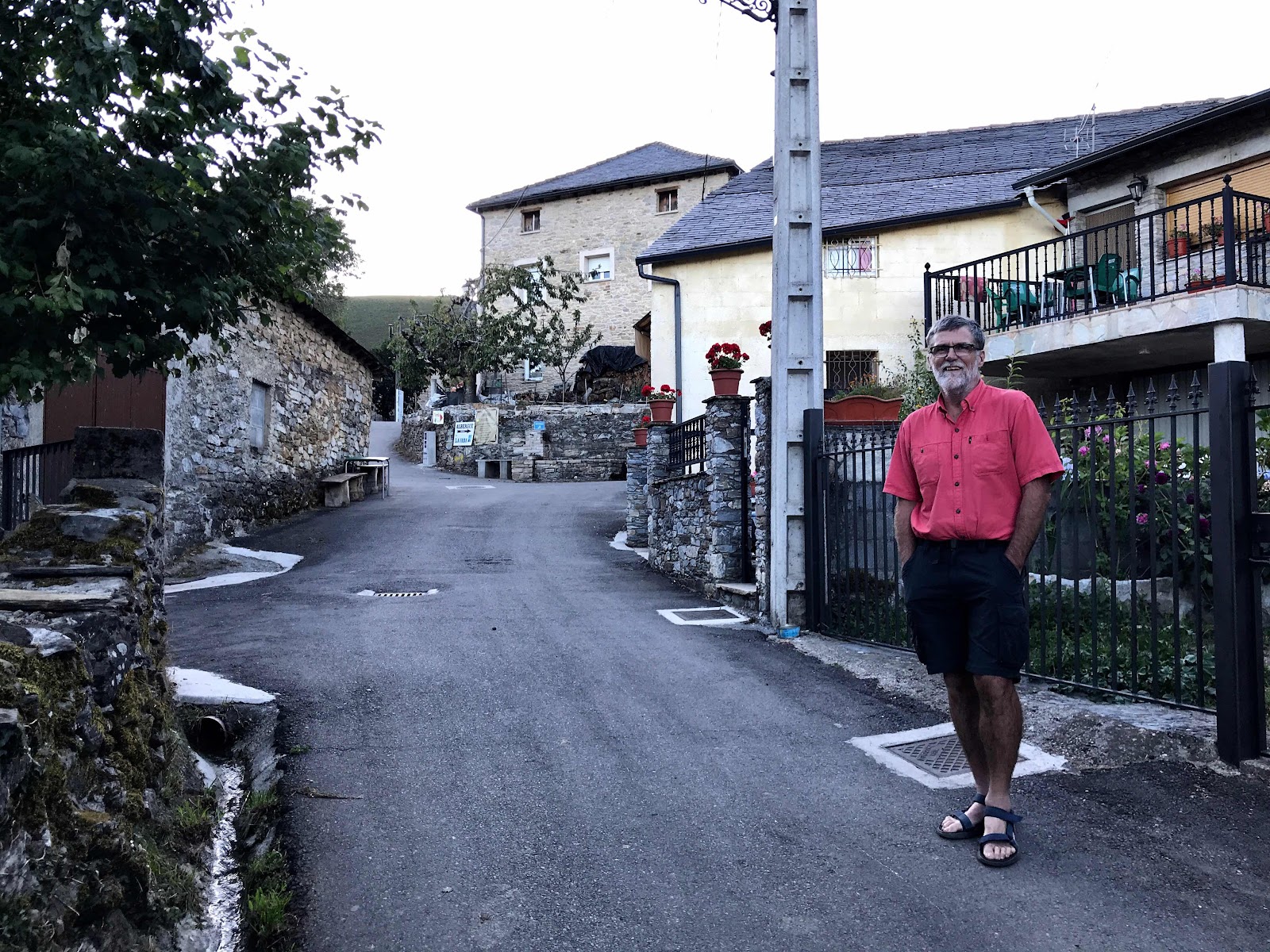
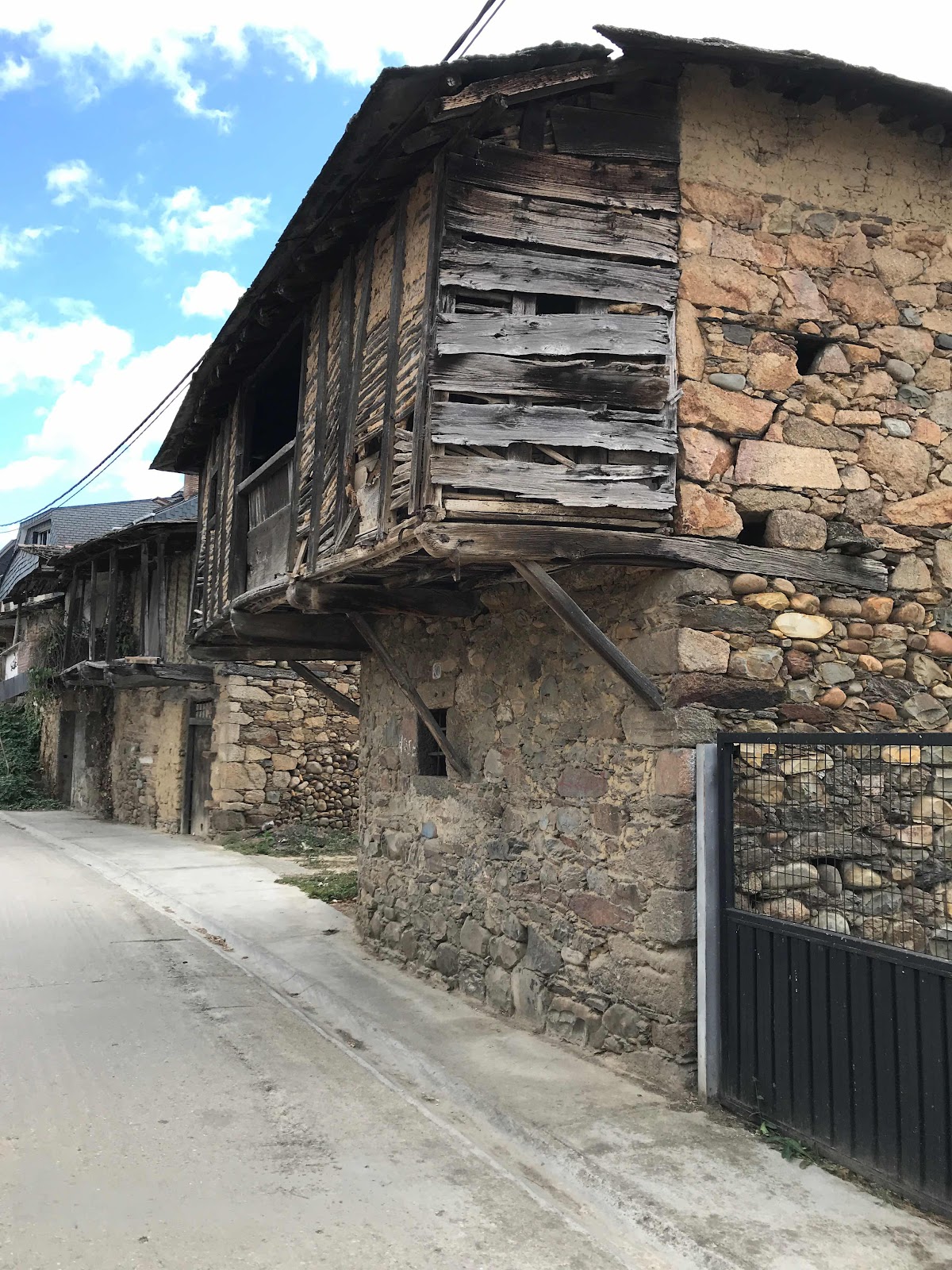
Since we entered Galicia, the markers for the trail have been much more prominent and nicely done. Every road intersection has a marker. It is much easier to find you way and I find myself not using my GPS nearly so much. Of course, we are getting nearer to Santiago and the number of people now walking the way has greatly increased. O’Cebrieno is a popular starting point. Guessing, I would say our numbers have doubled. We understand that 2000 people a day arrive in Santiago. Up to this point, I could not see those kinds of numbers, but now . . . we aren’t there yet, but the next big town we hit, Sarria, is the most popular starting point on the “way”. We will see how many join us later today, although we probably won’t notice their numbers until tomorrow.

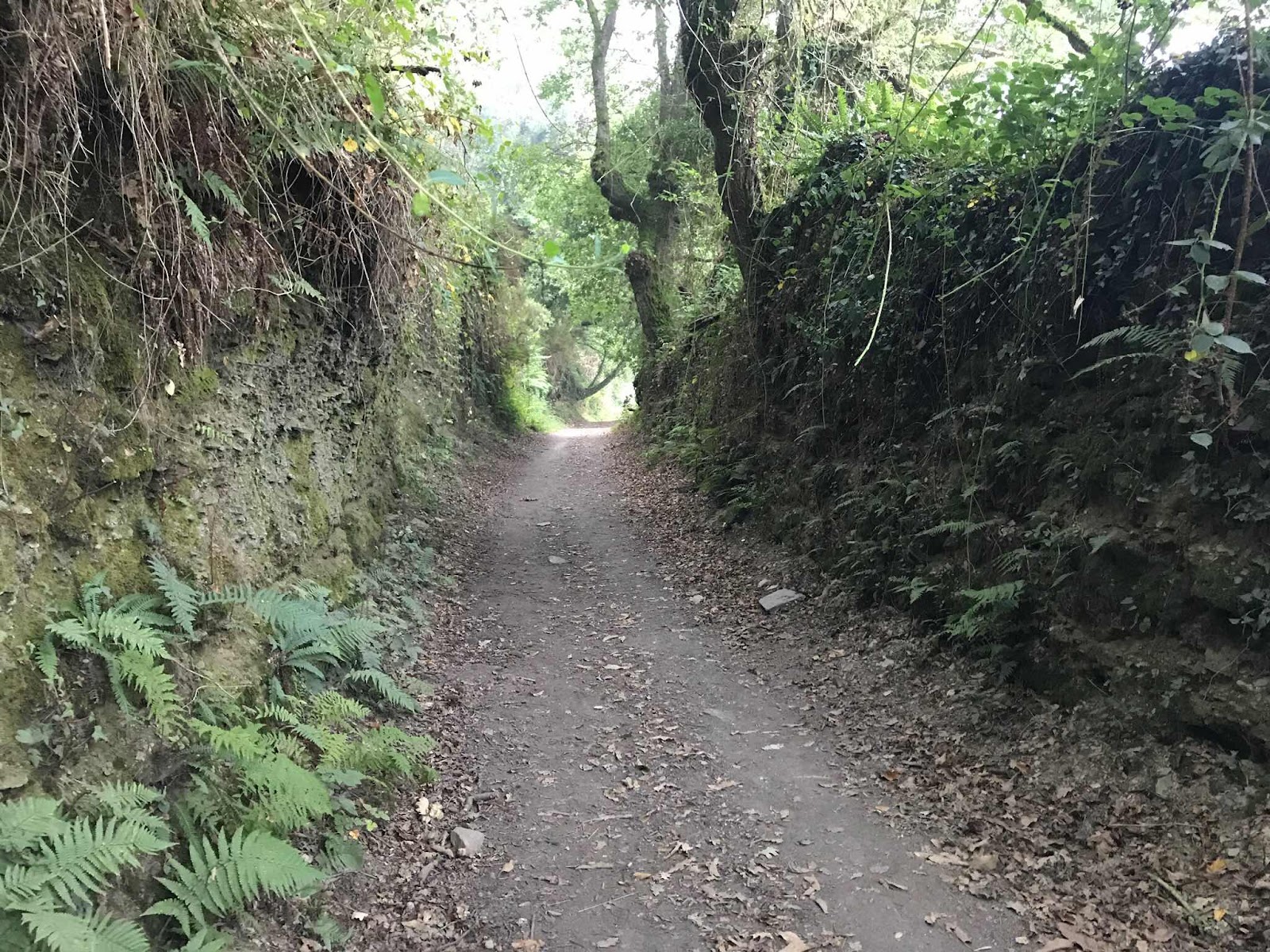
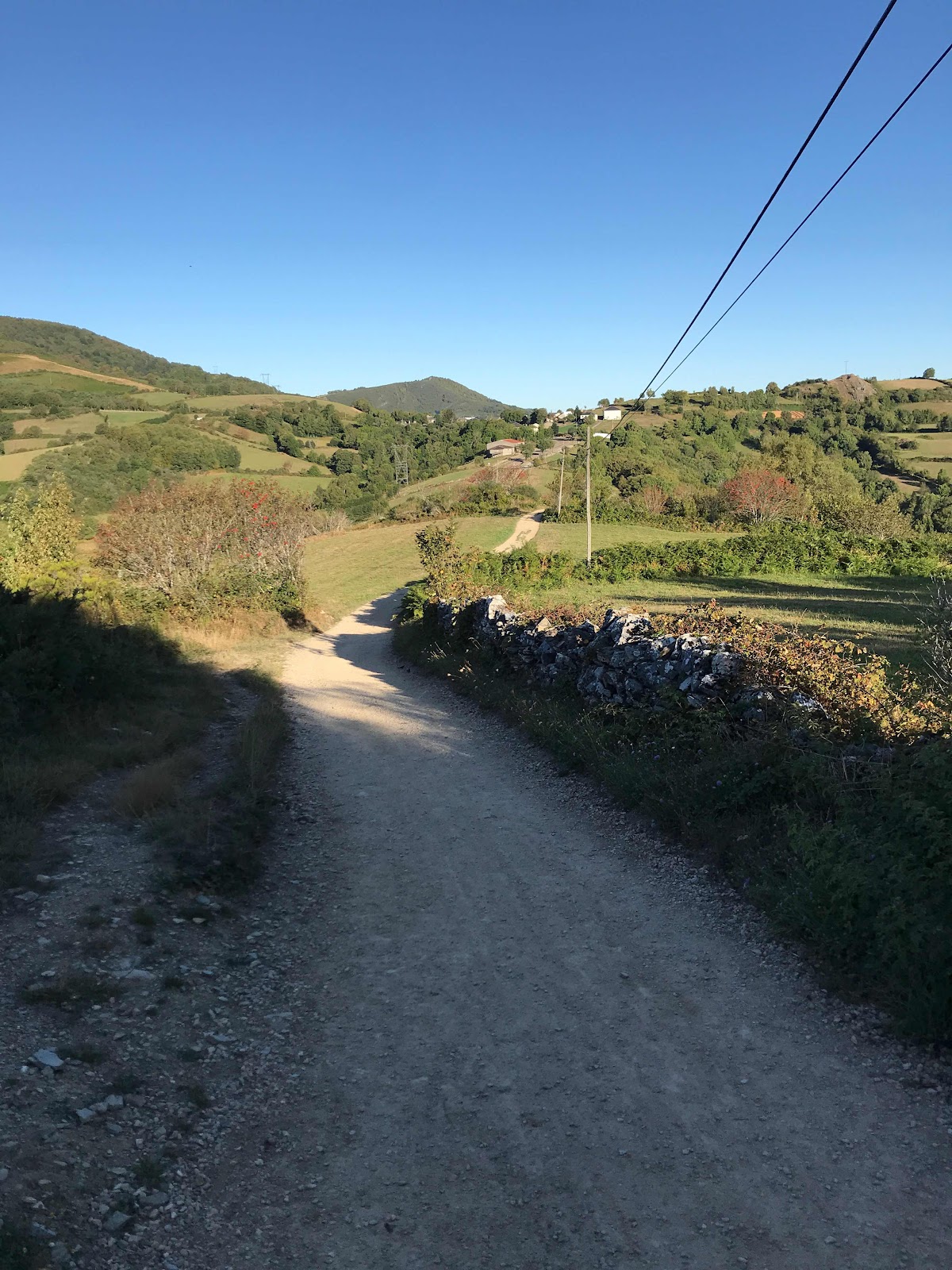
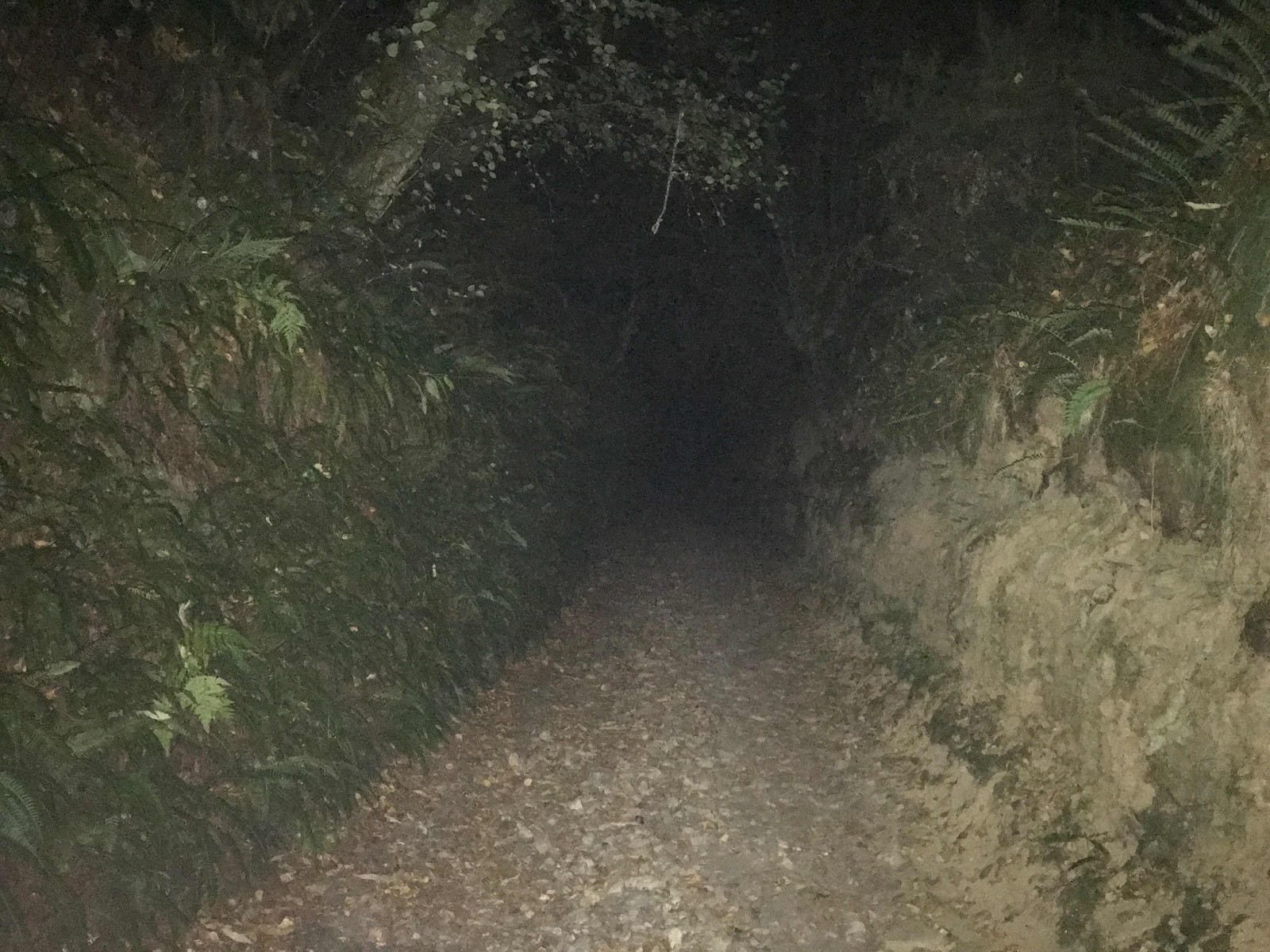
We tiptoed out in the morning, dressed, washed up and had breakfast in the downstairs kitchen, then walk through town and back on the “way”. The route followed farm roads through hilly country. Sometimes the road was remarkably steep. We witnesses what 1000 years of water erosion can do to a trail. At times we were walking in a ditch over 8 feet deep and wide enough to drive a car down. I imagine that over the years as the erosion gouged out a portion of the trail tread the locals ran evened out the tread for carts, thus lowering the whole road a bit. 1000 years of this creates a very cool road, like a luge track.

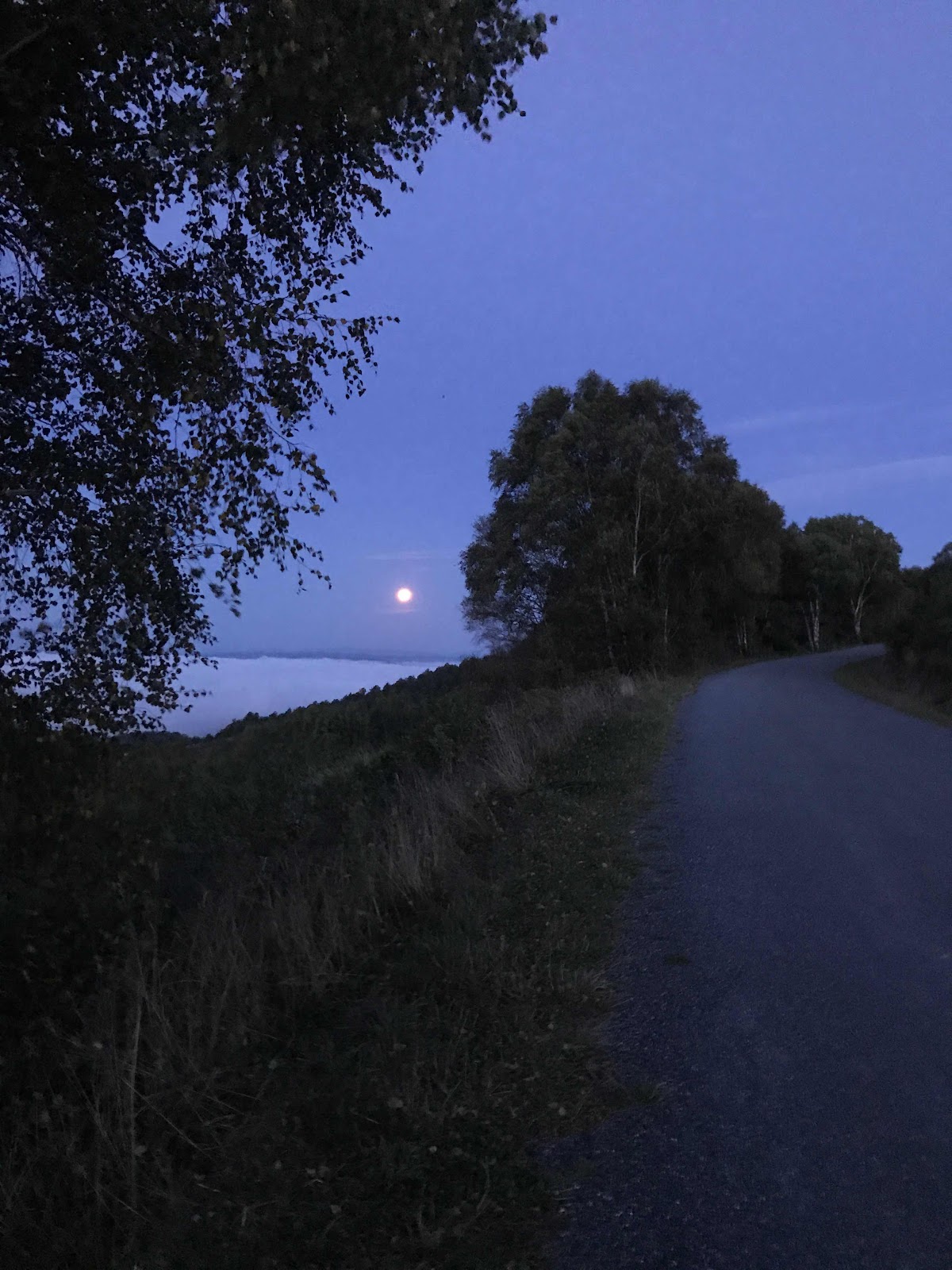
We ended up on top with the roads traversing through farms, the full moon shining on the western horizon. It looked like rural Lewis County minus the mobile homes and excessive junk piled around the outbuildings and houses (no cracks about excessive cars).

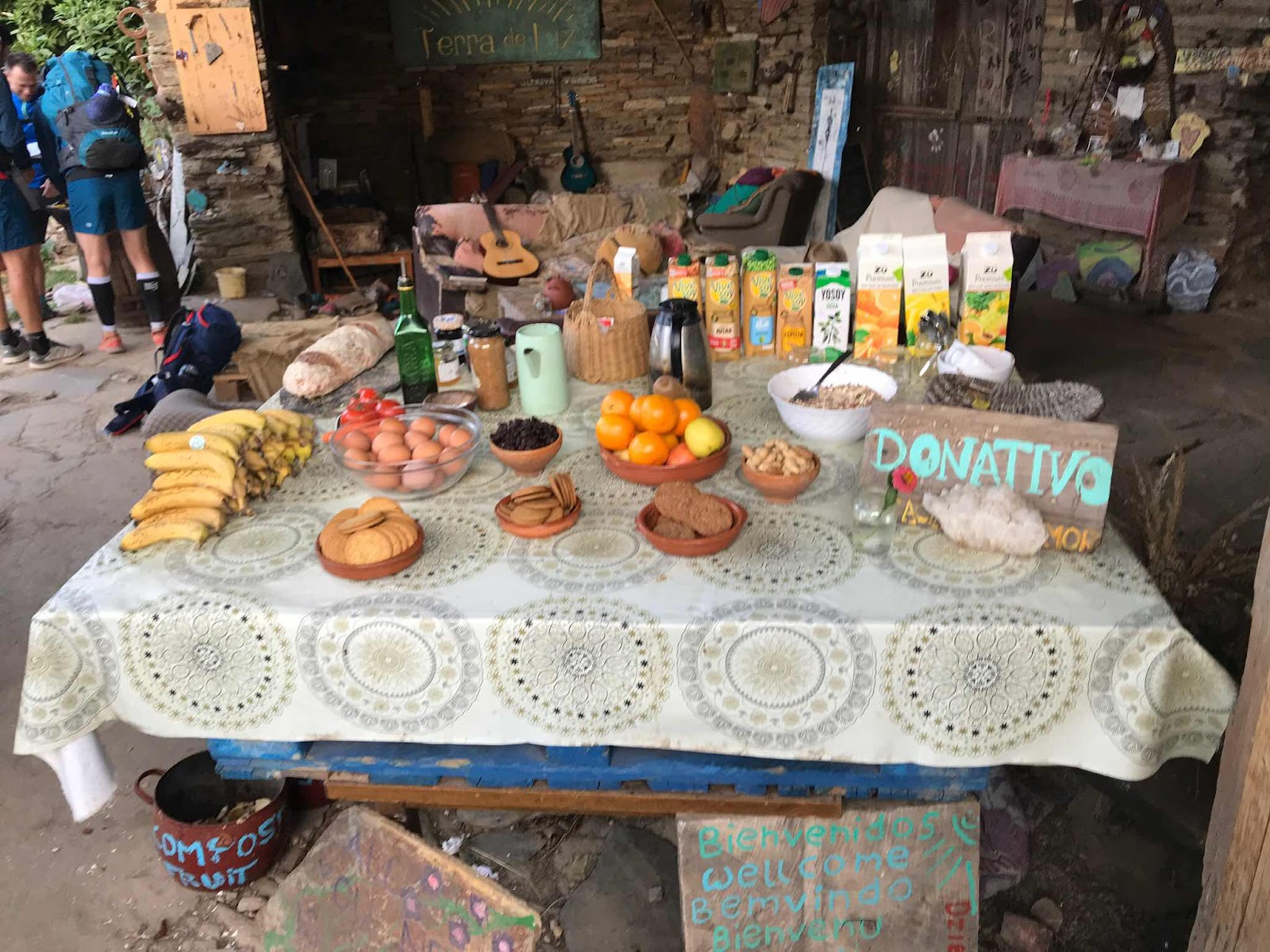
The stops were not as plentiful as the day before and we found ourselves looking for a shot of caffeine after a couple hours underway. About this time, as we were walking next to a walled in home we came upon their open gate.  This turned out to be a German run rest station with tables of food set out and a donation box. We stepped in and had some cookies and tea, a much needed stop. We also talked to a German volunteer, a kid in his mid 20’s. Nice, kind kid.

After another hour we found an open cafe and stepped inside. Now we were beginning to see the increase in people. While stopped, at least 25 people joined up inside or at the outside tables and another 50 walked past. As we approached this cafe we met Nancy and Maggie from Ireland and had a good discussion about Brexit, Johnson, Trump and Irish history. 

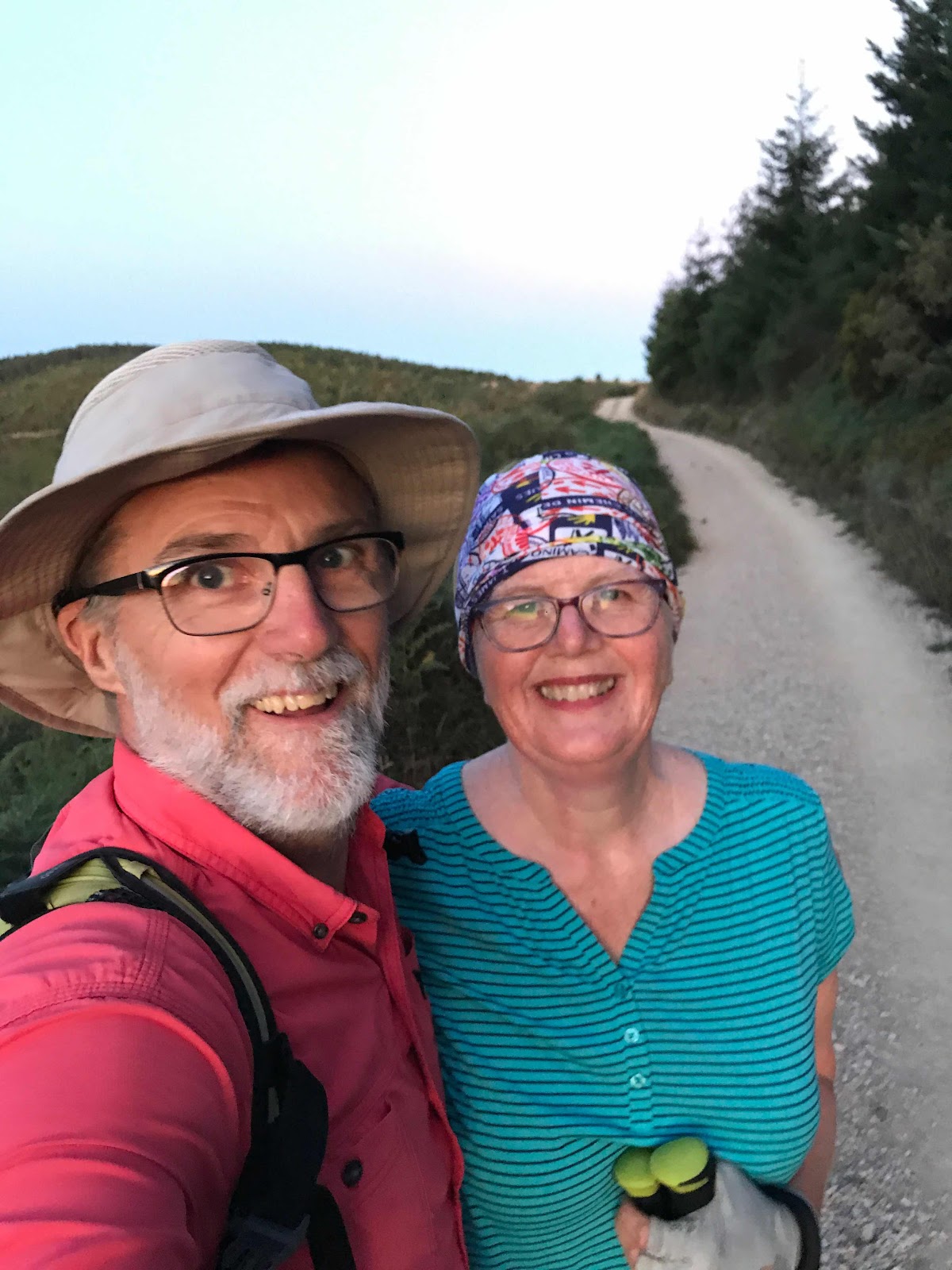
We got to Sarria about 11:30am.  Feeling strong, we continued onto Barbadelo, about 3.5 miles outside of town. Once across the river in Sarria it is a healthy climb up into town. Stopped at the top for a soda and met Peter from Denmark. We had met him the previous two morning, in the dark, as he passed us. Now, for the first time we got to see what he looked like. We chatted for a few minutes before we headed out of town, he going to the same place as us, Casa Barbadelo.

Down the hill out of town, past corn fields (we stole two ears of corn), then up a steep hill and another half mile to the albergue.

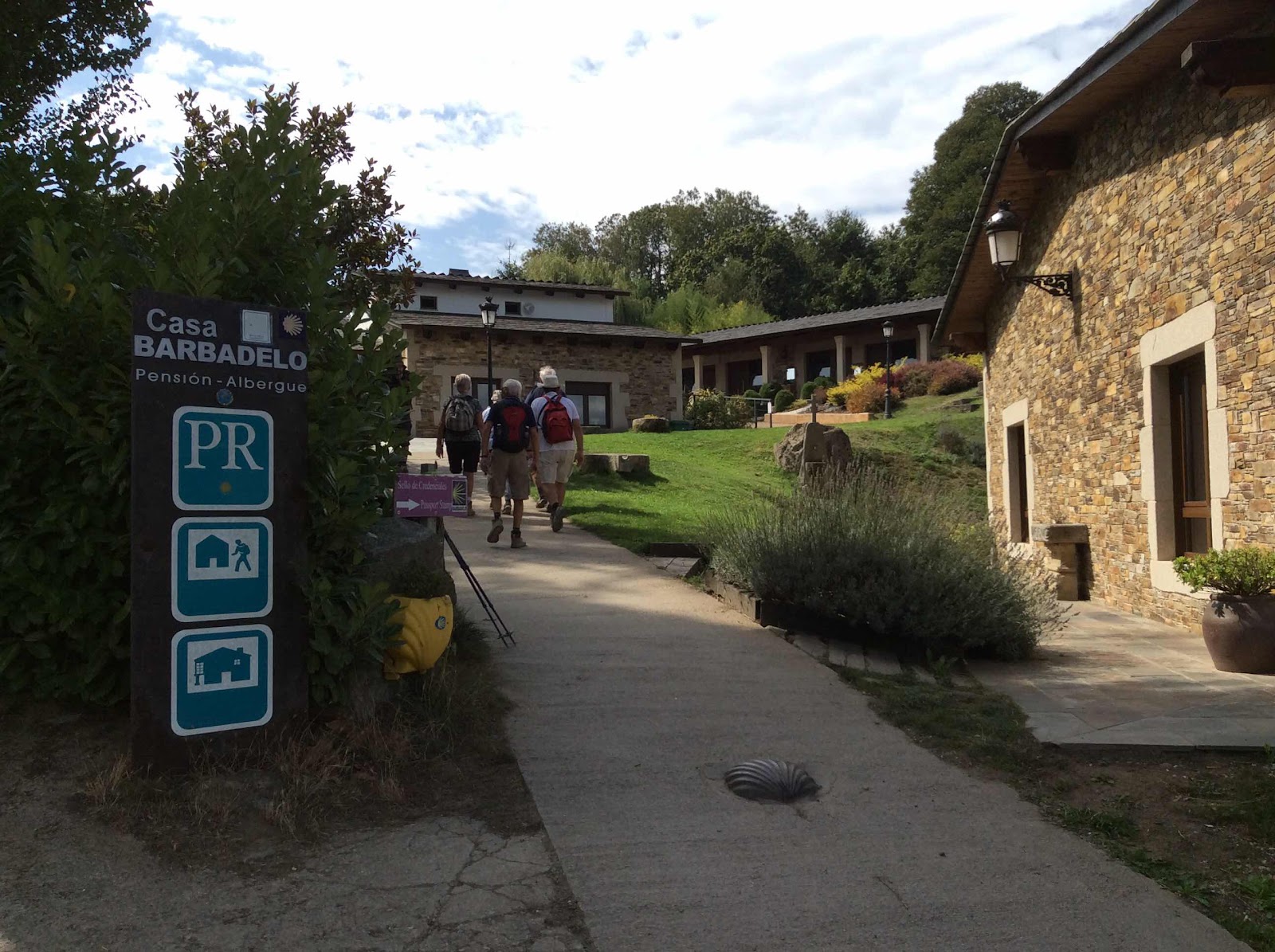
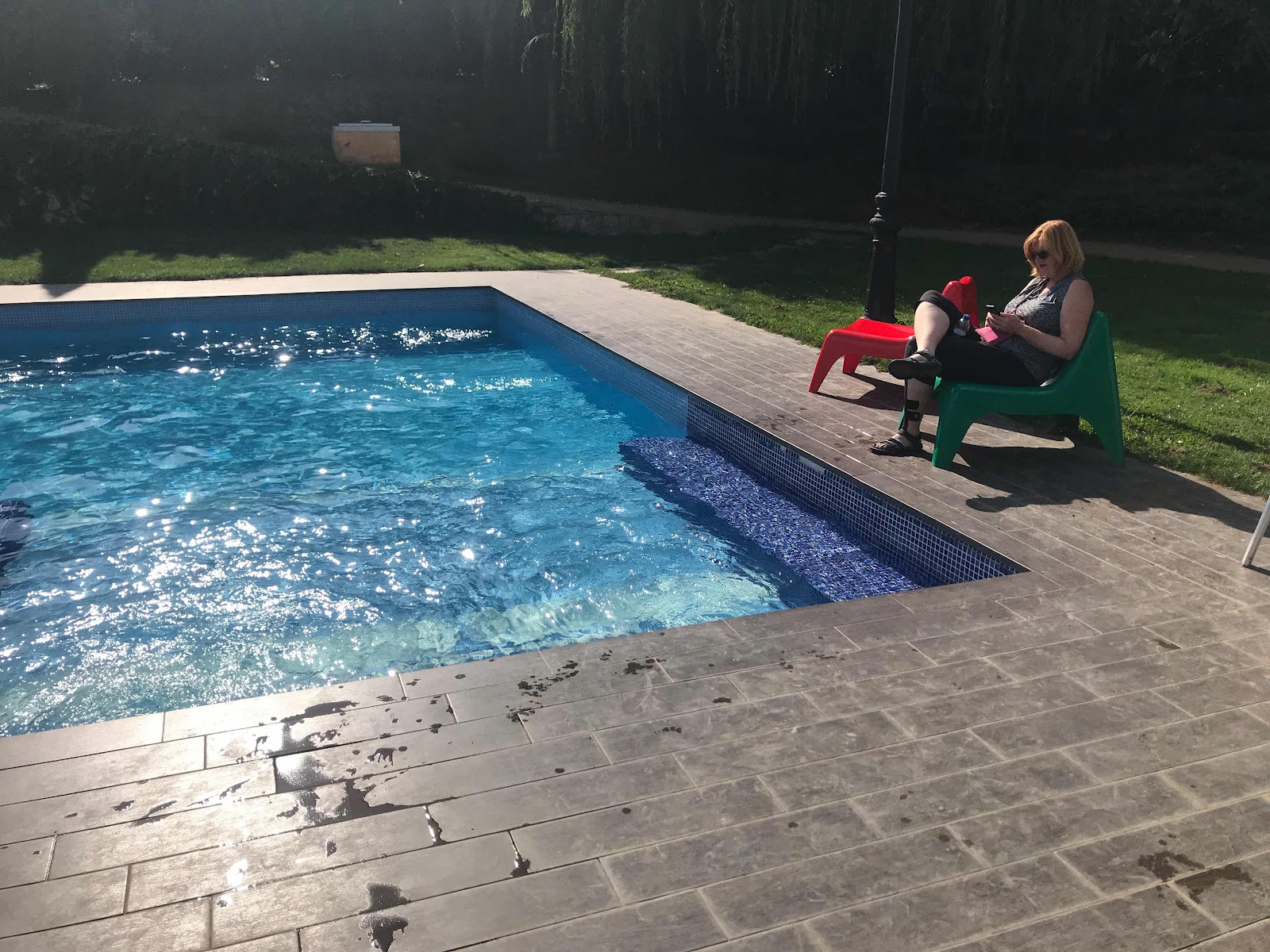
This one was like a resort. New and modern, with a swimming pool. 10€ each for the night. We laid in the grass planning out the next couple days and making reservations, inspired by the numbers of people we were seeing.

We ate dinner at the restaurant, splitting a salad and potato quiche. We sat with Peter. I was still hungry, like starving after our shared meal, so I ordered the 3 course, 10€ pilgrims meal, spaghetti, seafood papea and chocolate cake. It took about 2 hours to get through the courses as the waiter was slow to bring each one, but we enjoyed talking with Peter through it all. Of course, we did not finish until after dark, which is quite late here as you will realize if you read my ramblings about time zones. We snuck into our dormitory, packed quietly, then realized we had not phoned to have our bag transported in the morning. I stepped outside and called, struggled with the Spanish/English divide, but produced enough Spanish that we had an understanding and stepped back inside to sleep. 

Great day, lots of miles, good people, nice dinner. One more in the record books. What will tomorrow bring?


1000 years of erosion?


Food for pilgrims along the “way”


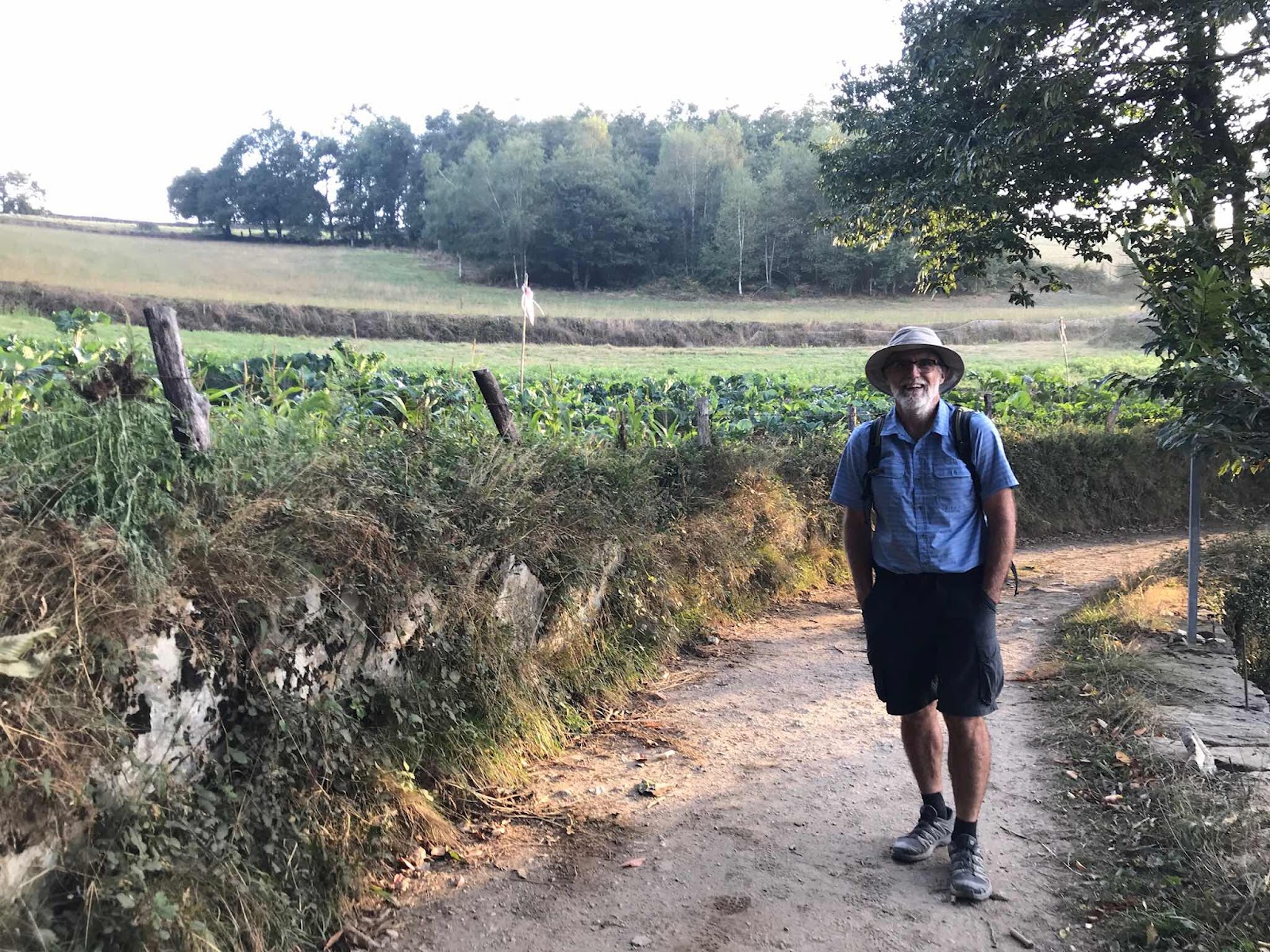
Through the farm lands


Trail in a ditch


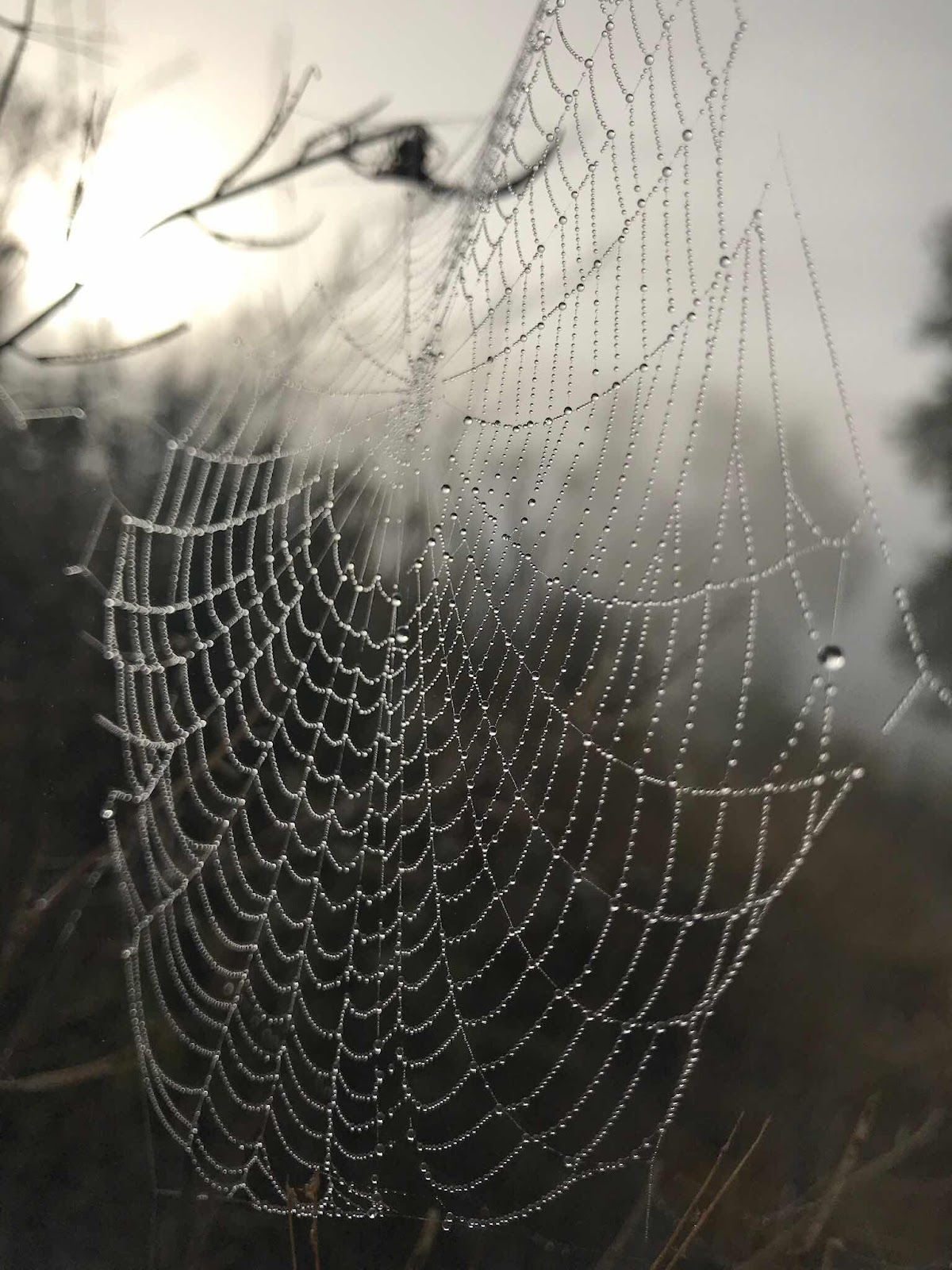
Lots of moisture in the air. Spider webs were amazing. 


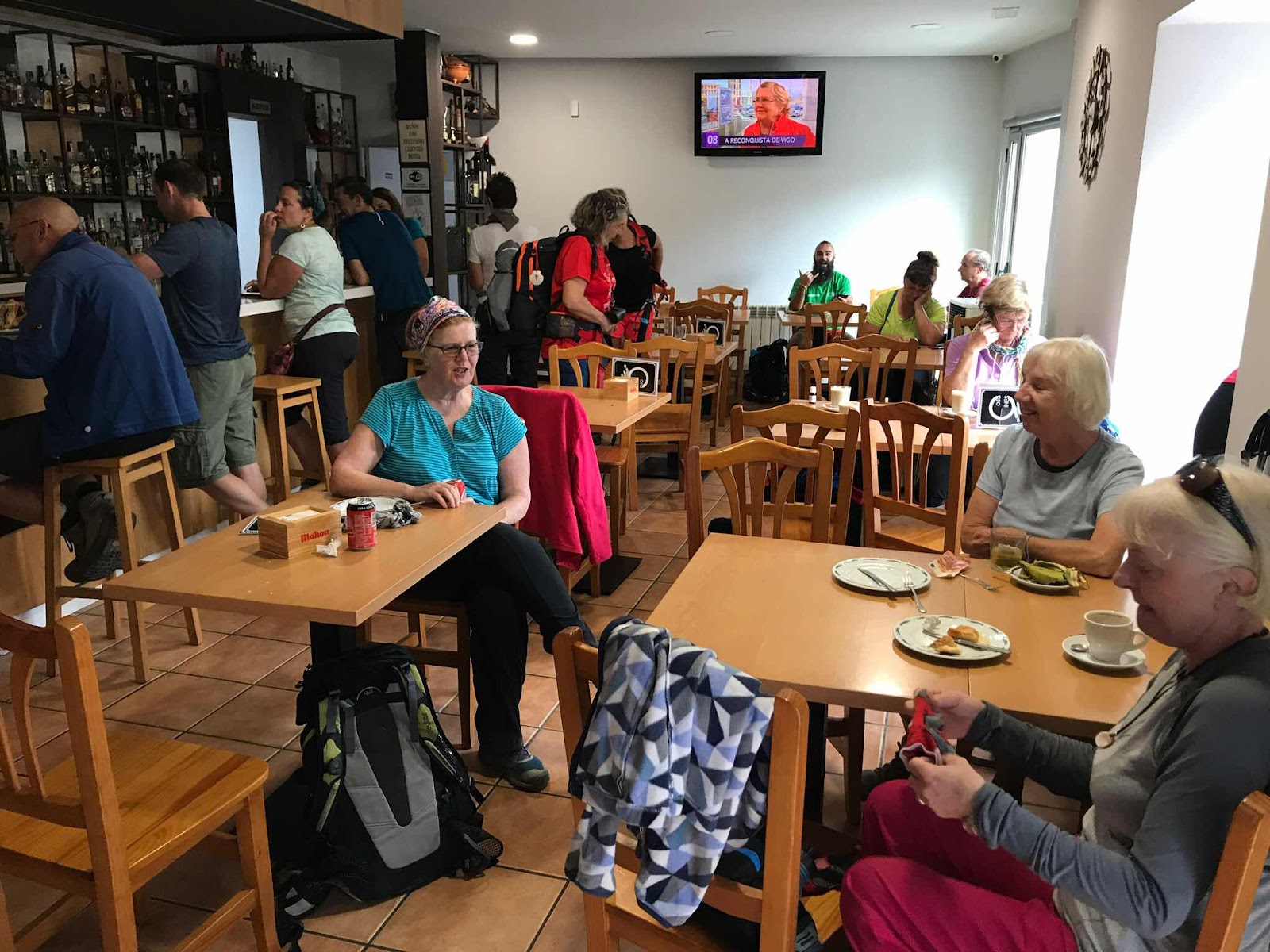
The crowds of pilgrims begins to grow


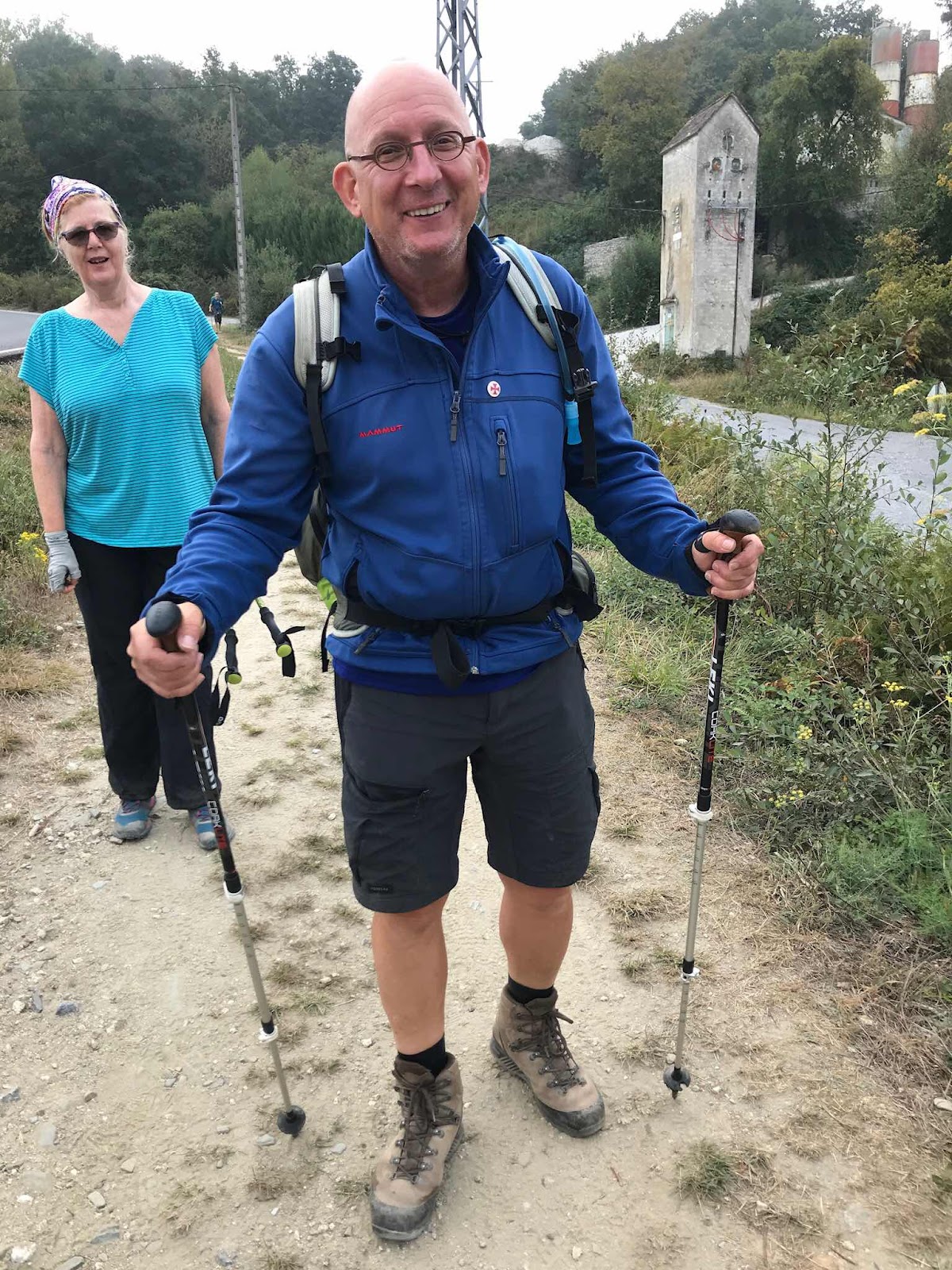
Andrew of Germany. Walked this way many times before. 


A group of heart attack survivors walking the Camino. Some for the 7th time. 


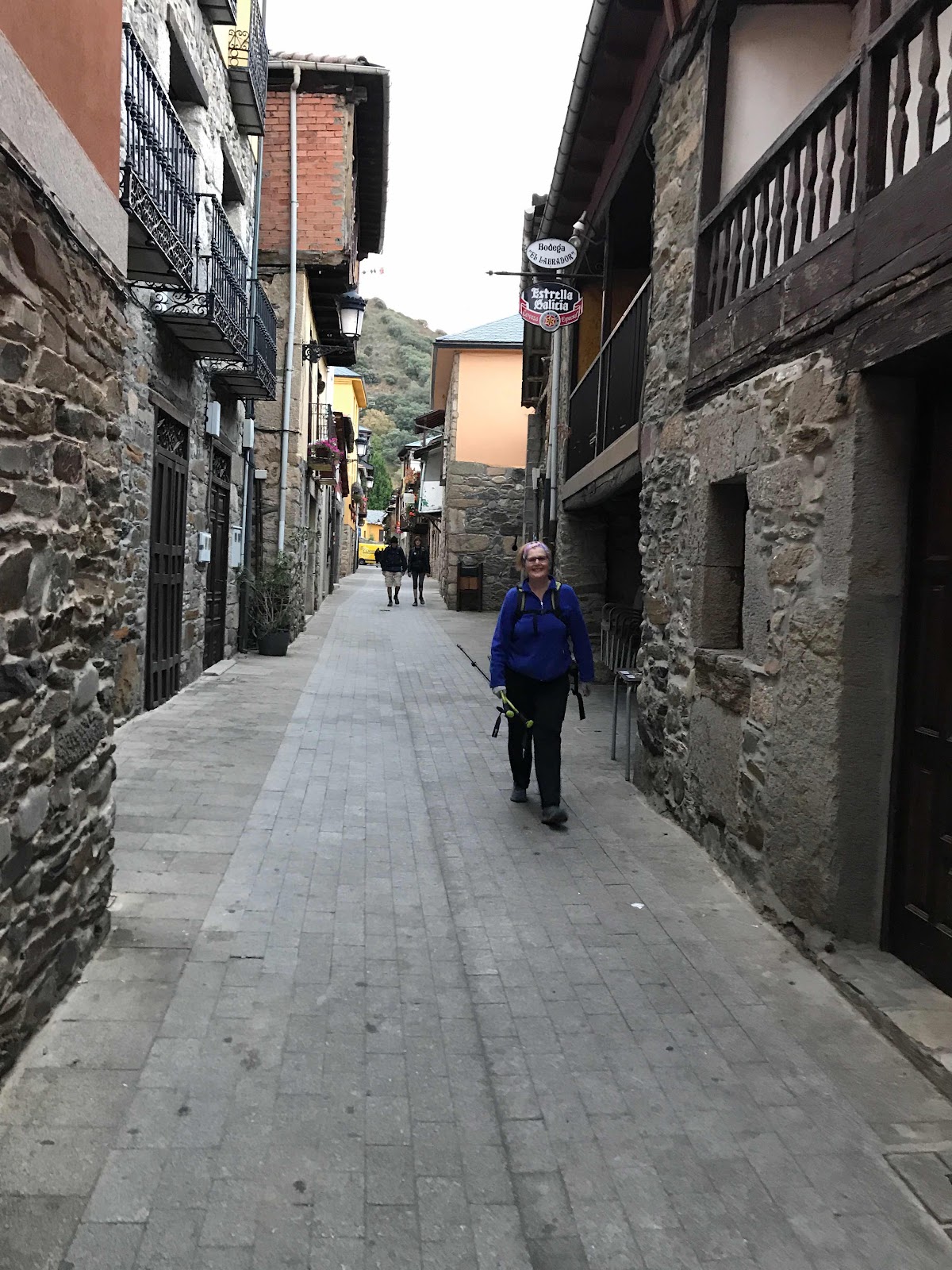
Sally in Sarria, climbing up thru town


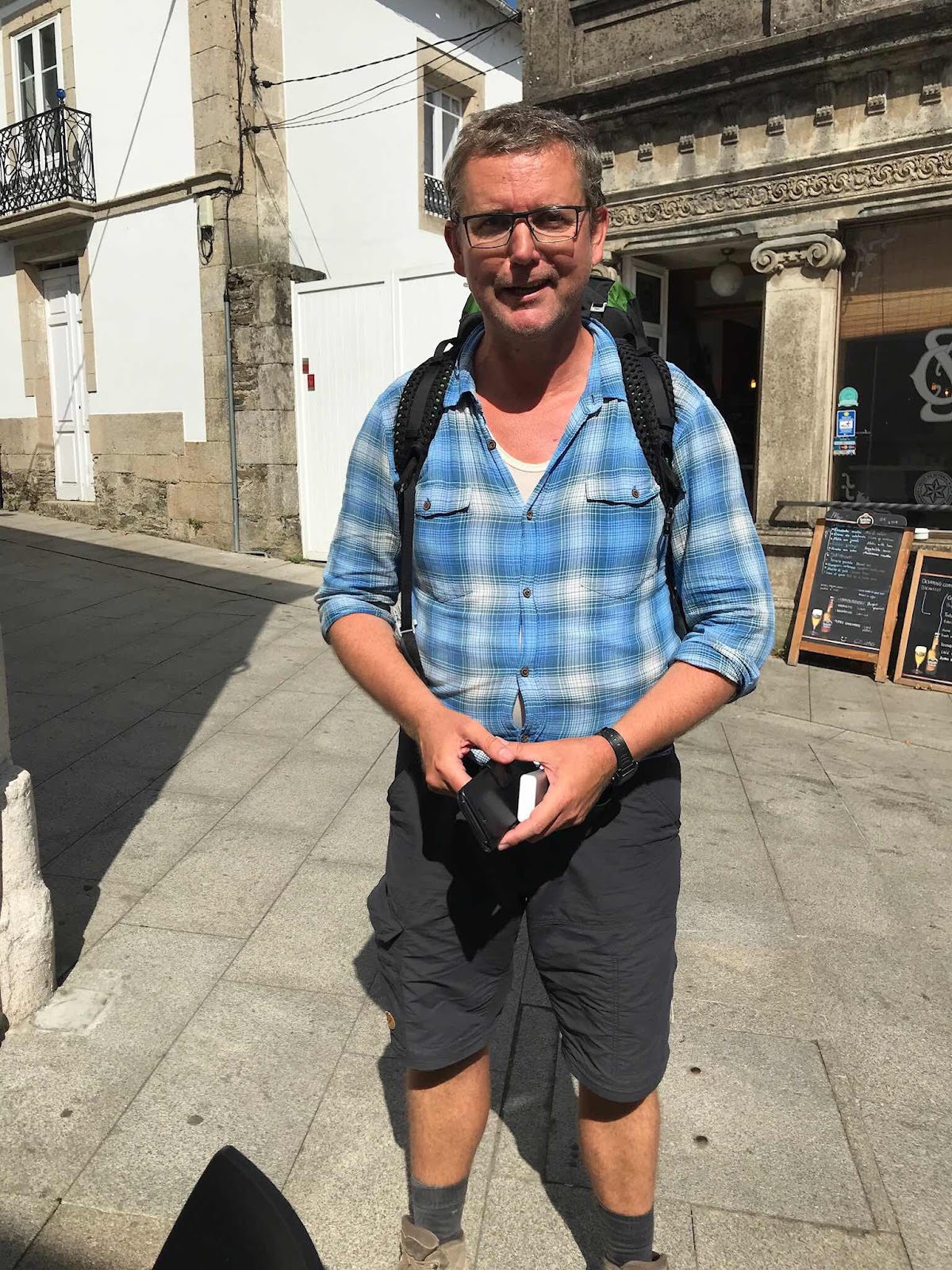
Peter of Denmark. 


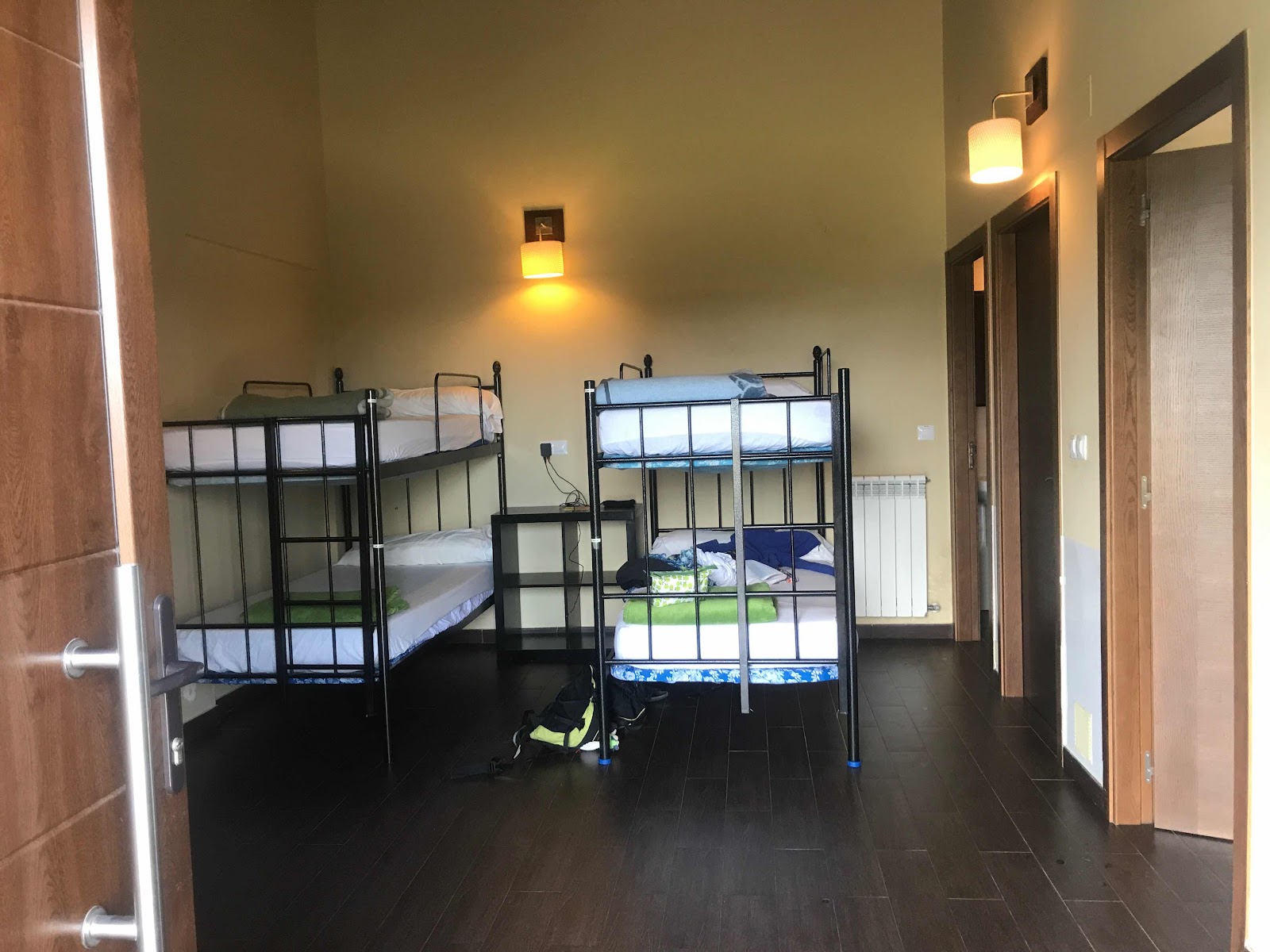
The dorm room


Casa Barbados. Great place to stay. Bunk beds too soft. 


Sally poolside
Day 16 - Friday, September 13, 2019 - La Faba to Triacastela - A Very Social Day - 17.02 miles - Total Miles to Date - 193.26


The frequency with which we encounter towns each day as we hike is increasing. On day one, hiking from Burgos to Hornillos del Camino we encountered 2 towns, Tardajos and Rabe de las Calzadas. It was 6.7 miles from Burgos to Tardajos, the 1.36 miles and finally 4.86 miles to our destination of Hornillos.  Two towns in the 13 miles. Today, we encountered 10 towns in 17 miles. The longest distance between towns was 2.13 miles. As we get closer to Santiago, the towns are getting closer together. Why? Is it topography?  Most likely. The Meseta was composed of grain fields. Towns were few and far between. Now we are in the mountainous regions (hilly really). The towns are now strung together like pearls on a necklace, a short jump from one to the next. This creates a bit of a party atmosphere along the way, somewhat like a moving party. Everyone stops at nearly every eatery/pub along the way (usually these towns are small-one pub per town) so that every half an hour everyone gets together again and the conversations start up where they left off at the last pub. Andrea, from Denmark made it a point to have a coffee or a beer, or both, from each eatery along the route. This made for a lot of fun today, as every half hour was a reunion of sorts. In our traveling entourage was Andrea and his wife Hannalea, John and Dana, ReLuca, Andrew, Aaron, and a few others. At one stop in the morning we met Colton Ort, a musician of the Bob Dylan genre, about 22 years old. He offered to play for us as we sipped our Colas. He is really, really good. He sings folk songs from the 30’s and stuff he has written.  He will be worth following in the future. We thought we would see him often during the day, but we must have gotten out of sync with him. One performance was all we got. 

This morning we started the day climbing about 800 vertical feet in 3 miles to the ridge top town of O’Cebrieno. It has been rebuilt in the last 20 years and is a picture postcard village from yesteryear, a Disneyland of the Camino Pilgrimage towns. No town every looked this perfect in the old days. Still it is a joy to see such a stylish and well constructed “town”. From this ridge top village the trail oscillates up  and down as it follows the ridge for the next 4 or so miles, hitting small village after small village (by small, I mean one or two buildings, one of which is a cafe). Then the way starts down for about 6 miles until the town of Triacastela is reached in the river bottom below.

We reached Triacastela about 3:30pm, quite tired with the long downhill. Sally had developed what appeared to be shin splints earlier in the day. We used KT tape as instructed in their YouTube video and it worked GREAT. Even with all that descending her shin splints did not advance.

We made a trip to the grocery store and bought dinner, breakfast and lunch supplies. Our albergue had a complete kitchen, so we made pasta and vegetable soup from canned vegetables because fresh vegetables were not available.  At the grocery store we ran into Dana and John. They looked so clean and well dressed!  They brought big suitcases with many changes of clothes that they have shipped from hotel to hotel, so they are not living the spartan lifestyle while hiking the “way”.

The kitchen was downstairs. We had it to ourselves. Learning from the last time we cooked dinner, I cut the portion by a factor of 4, noodles, can of mushrooms, can of mixed vegetables and a chicken bullion cube.  Delicious, with yogurt for desert.

We had washed our clothes in the sink earlier, hanging them in the sun to dry. We picked them up after dinner, then retired to our shared room to write and rest. There were 4 bunk beds in the room, but the other 6 people were not there. We had not seen them all day. About 9:00pm they came in. A group of 6 Spaniards traveling together, it was their last night. They were taking a taxi to Leon in the morning, then heading home.  

An amazing day. Much of the trail was up on the ridge top, giving great territorial views. Many stops along the way, greeting new and old friends along the way. 


Sunrise on the climb to O’cebieno


Today we passed from the Lyon&  Catilla  “state” to Galicia. Galicia has a language that is a mix of Portuguese and Spanish with a Celtic influence. They are very independent oriented. 


Two pilgrims on the trail


One of the statues in O’Cebrieno


A recreation of houses used in this area


O’Cebrieno is the home to the priest that revitalized the Camino in the 70’s. Less than 100 people a year back then to over 400,000 now. 


The “way”


Midday stop along the way


Friday, September 13, 2019

Day 15 - Thursday, September 12, 2019 - Trabadejo to La Faba - A place of tranquility - 8.56 miles - Total Miles to Date - 176.24 miles


I don’t think we fully understand the importance of the United States in the world. Yes, we here it talked about on the news, but until you travel with hundreds of people from countries from all around the world and talk to them for hours at a time, you can’t truly comprehend the influence of the US in all aspects of human life on this planet. Let’s examine just a few.

As I walked down the trail with Rosella, a 52 year old woman from Italy we talked about politics and languages. She was constantly working on her English, trying to get better. I said I had trouble picking what language to study. She said, “Your lucky, you already speak and know the most universal language on the planet, English.” Yes, Great Britain speaks English, but the US influence in the world makes English the universal language.

Tonight in the albergue, a German man was playing the guitar. About 10-15 people were hanging around with him in the kitchen. Did he play some old German ballad? Some Spanish guitar work? No. Woody Guthrie’s “This Land is Your Land”. And 15 voices, accented in German, Spanish, Italian, Finish, and more sang together. Their second song? John Denver’s “Country Road”. Their third song? “The House of the Rising Son” about New Orleans.  This all occurred in La Faba Spain, a small village up in the mountains in a gorgeous albergue run by German volunteers. What reach the United States culture has.

Every time we meet someone new who is not American (this happens about 20 times a day) we apologize for our insane president and actions our country have taken under his “leadership”. Everyone of them knows who he is, what he has done and much about the political system of the US, right down to the electoral college. Think for a minute. What form of government does Denmark have? Who is their leader? Germany? France? Netherlands? The US is such a major player.

How about technology? Every time we swap emails addresses with someone, guess who their email provider is . . . gmail. Every computer runs Windows software. Apple phones are everywhere. It is fun to hear someone with a pronounced Dutch accent say, “You can google that.”  Half the tractors we saw are the familiar John Deere green and yellow. 

The point is, the world looks to the US. They are waiting for us to provide leadership and set a tone and standard for behavior, policy and ethics. They don’t want us to run their countries, far from it, but they expect the US to set a high standard, not retire behind our borders with an “us first” attitude.

The hike from Trabadejo to La Faba was short, only 8 miles. Knowing this, we slept in a bit, getting up at 6:05am. We were on our way by 6:45am, walking roads for the first 6 of 8 miles, sometimes on the highway with no shoulders, but only for short distances. We passed through some small villages, nearly empty, and stopped for a pastry and some hot tea at a bakery in La Portela de Valcarce. Did I mention it was freezing cold this morning? About 39º. The hot tea was just the thing, and the 20 minutes in the bakery let the day warm a bit.

We were in no hurry. We talked to many people, not feeling the urge to move quickly. In Las Herrerias we enjoyed the pasture in town, the cafe and the people seated outside. 

This adventure is Sally in her element. She introduces herself to nearly everyone that passes when we hike, that is seated near us at a cafe, that sleeps in the albergue near us.  She treats each with respect and a genuine interest and thanks them for their time upon parting. Together we work to try to remember all the names, Rosella, Roberta, John, David, Dana, John, Valerie, Denise, Raluca, Fermin, Regina, Jan, David, Barry, Jim, Sara, Hanalee, Aaron, Karen, Tanya, Kelly, Jan, Mike, Alba, Maxi, Gonzalo, Nerea, Raul, D’Anne, Anna Marie, Isabel, Ren, Brian, Sandy, Sophie, Maggie, Nancy, Andre, Horjei (Horga), Andrew, Thorston, Lorenzo, Gaia, Verena, Juergen and. . . . These are the names of the people we have met over the past 220 miles on the trail, at least the ones I can remember off the top of my head.  I am sure there are 50 more I can’t recall. Some names are repeated because we have met more than one person with that name. And some of the people have names so foreign to us we can’t remember them, let alone spell them.

From Herrerias we climbed steeply for a couple miles to the town of La Faba nestled on a level spot on a ridge. This is our favorite town to date. Small farms nestled on the level portion of the ridge, buildings tightly clustered together as if they gather strength from each other to cling to the hillside. Out toward the end of the ridge is the church with the most beautiful albergue we have stayed in to date. Run by German volunteers, it is spotlessly clean, well designed and organized and located in an idyllic location.

Sally went to lunch with Valerie shortly after we arrived and I went around behind the church, found an outside stone table and wrote for an hour. The albergue opened at 2:00. Sally and Val returned at 1:50 and I came out of seclusion to sign in and get our beds. We got the best beds in the house, far from the door and tucked behind a wall, almost as if we had a private room.
We spent the rest of the afternoon in the kitchen seated at a table planning the rest of our trip. This included mapping out our daily mileages to reach Santiago in 8 days and making reservations at albergues along the way. This is not something we like doing. We enjoy being more spontaneous so we can shift plans quickly as we meet someone or an event comes to light that we want to attend. But, we have learned that the last 100 miles of the “way” gets very crowded. Tour groups bring in 100s of tourists to walk the last 100 miles and in particular the last 60. This puts a strain on beds in the towns. It is possible to walk into a town and not find a bed, necessitating one to walk to the next town to find lodgings. To avoid this, we are making reservations.

We cooked dinner in the wonderful kitchen, went for a walk through the small village and talked with folks. I spent an hour finishing Wednesday’s blog entry while seated in a lounge chair on the front porch of the cathedral. Sally communicated with friends on Facebook. Afterwards Sally joined the guitar group singing American songs and I prepared for bed. One more great day. Many more to come.


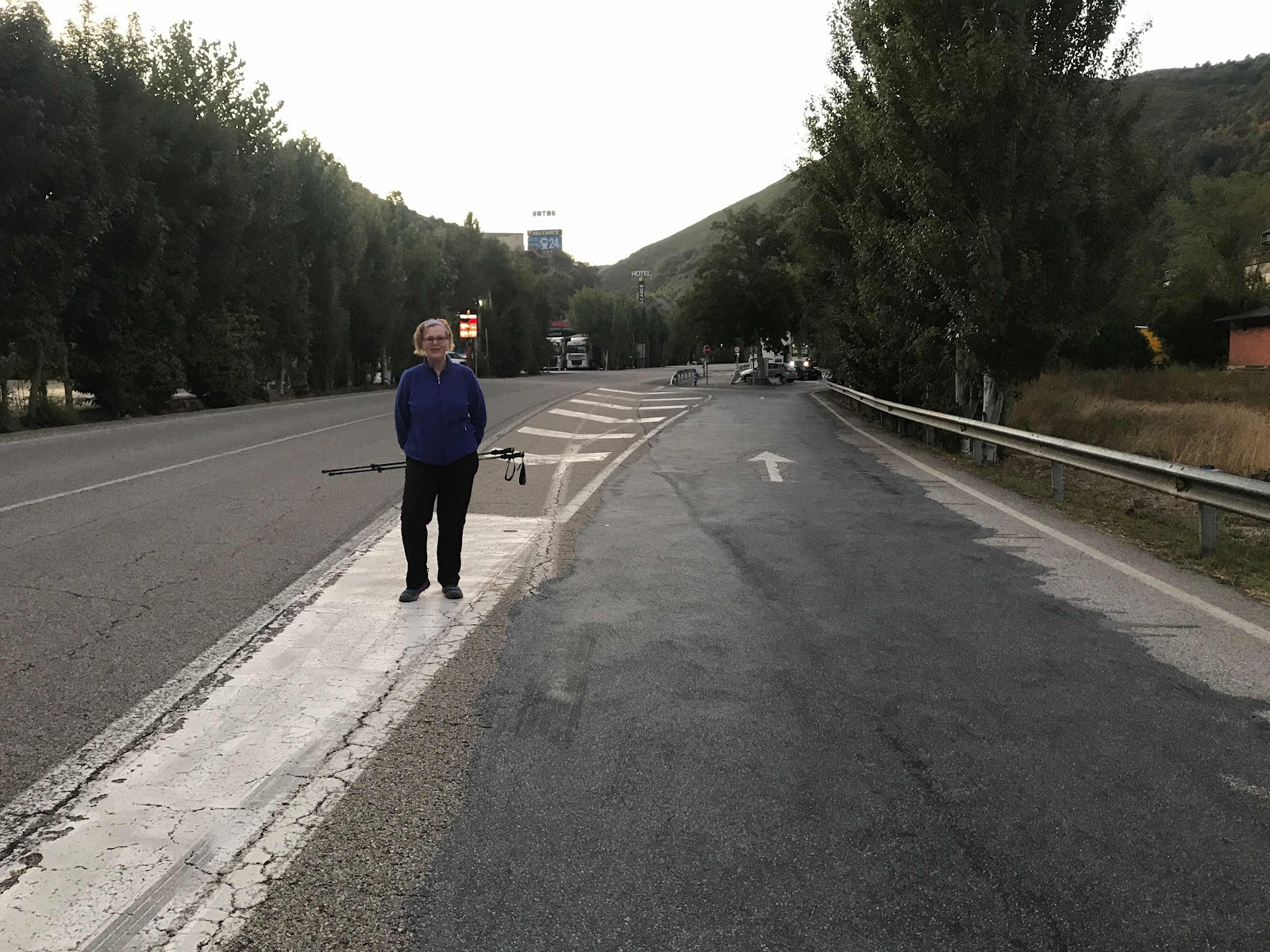
The trail was in the middle of the highway at times, but luckily not for too far a distance. We had to dodge a semi. 


The freeway is so far above the towns and trail we didn’t notice it. 


Beautiful places all along the way


Anna Marie from Denmark


Herriera- another quaint and cute little Spanish town. 


Main Street in La Faba


The Albergue and church in La Faba


The kitchen in La Faba albergue 


Another view of the kitchen


Downtown La Faba


Albergue on the left. Church on the right. 


Thursday, September 12, 2019

Day 14 - Wednesday, September 11, 2019 - Camponaraya to Trabadejo - A choice of paths - 15.26 miles - Total Miles to Date - 167.68 miles


We have met such a variety of people on this trip. Each is unique. The variation in their motivations for being here, their physical ability to do the walking, their background experiences, their income level and the method with which they attack this challenging walk is remarkable. 

This evening we met two ladies from Australia-sisters-Cheryl and Susie who are taking their time walking the way, as if time were a malleable commodity, easily molded to fit outside circumstances. Delay a day to allow something else to occur? No problem. Walk short days to save feet and see sites? Why not? Spend the afternoon getting to know another couple people who they just met? Perfect.

In Rabanal, two nights ago we met D’Ann, age 59, a former Toyota executive in charge of logistics for North America, newly retired. Utilizing her training and job skills of 34 years behind, she has reservations for every night made in advance, every distance preplanned. She mostly stays in private hotels with the occasional albergue common room. She prides herself in speed hiking and motors by most everyone on the trail. She arrives at her hotel room around noon or a little after, showers, has lunch, naps and goes to dinner.
We met Jan, age 31 of Germany. He wants to walk far everyday and describes the long distances he will probably walk, but then often gets to talking, or meets someone and ends up doing about 12-15 miles instead of the 20-25 he envisions himself doing.

Anna Marie of Denmark, age 20, has struggled with foot problems since we met her weeks ago in Frómista. She is bubbly, lives up to the “happy as a Dane” ideal, has no travel itinerary, makes it up as she goes and is not sure what she will do when finished because she just finished high school and wants a gap year before she starts college.

Barry is a 67 year old, athletic man. He sees the Camino as an athletic challenge, setting long distances for himself each day. He is a semi-retired hedge fund manager with plenty of money to “get by”. He stays in private rooms for the most part. He has found the walking a challenge due to multiple foot injuries from blisters and walking weird to compensate for the blisters. He came to have some think time while walking by himself, but has not been able to.  All his mental energy has gone into pain management of blisters and injuries.

Of course, there are others, but it is fascinating to see how the Camino is different to each of them, how they react to the Camino and how they adapt their preconceived ideas of the Camino to the actual Camino now that they are well along on their journey. One common denominator: each finds the Camino a type of sanctuary for the soul. They each came to get something from the Camino, athleticism, spiritual renewal, connections with others, time to think and more. Each appears to be walking away with what they came to find and more than they thought they would find. Nearly universally, the people from over 70 different countries find they have everything in common as humans, at least the important things and are finding a community of people they feel a part of. The world would be a better place if everyone could spend a month+ walking the Camino interacting with people from all walks of life, all religions, all nationalities. It is a grand melting pot.

This morning we were in the downstairs foyer getting ready. The lights are automatic, as is true in nearly every building we have been in here in Spain. The lights come on when you enter a space and stay on, as long as you are moving. If you are standing still rifling through your pack, the lights go off about half way through your task of finding something, or packing. You must wave your arm to light the room again, and then try to keep moving to keep the light from shutting off again. Such was our actions this morning.

Once the morning routine was done, we were out the door and on the street. Sally and I were both sore from our 5 miles of downhill and 16.5 miles traveled yesterday. It took some distance before things loosened up enough for us to move smoothly down the street.

In the town of Cacabelos, as we walked down a narrow street, to our left was a bakery. No glass display cases, just a small transaction room with a glass wall that allowed you to see a brick oven 10 feet high and 20 feet wide with a door to access the oven. A paddle 14 feet long was used to shift trays of baking goods around inside the oven. We stopped in and bought two loaves of VERY fresh bread. One I ate over the next mile and a half. The whole loaf. The other we saved for lunch or dinner or breakfast.

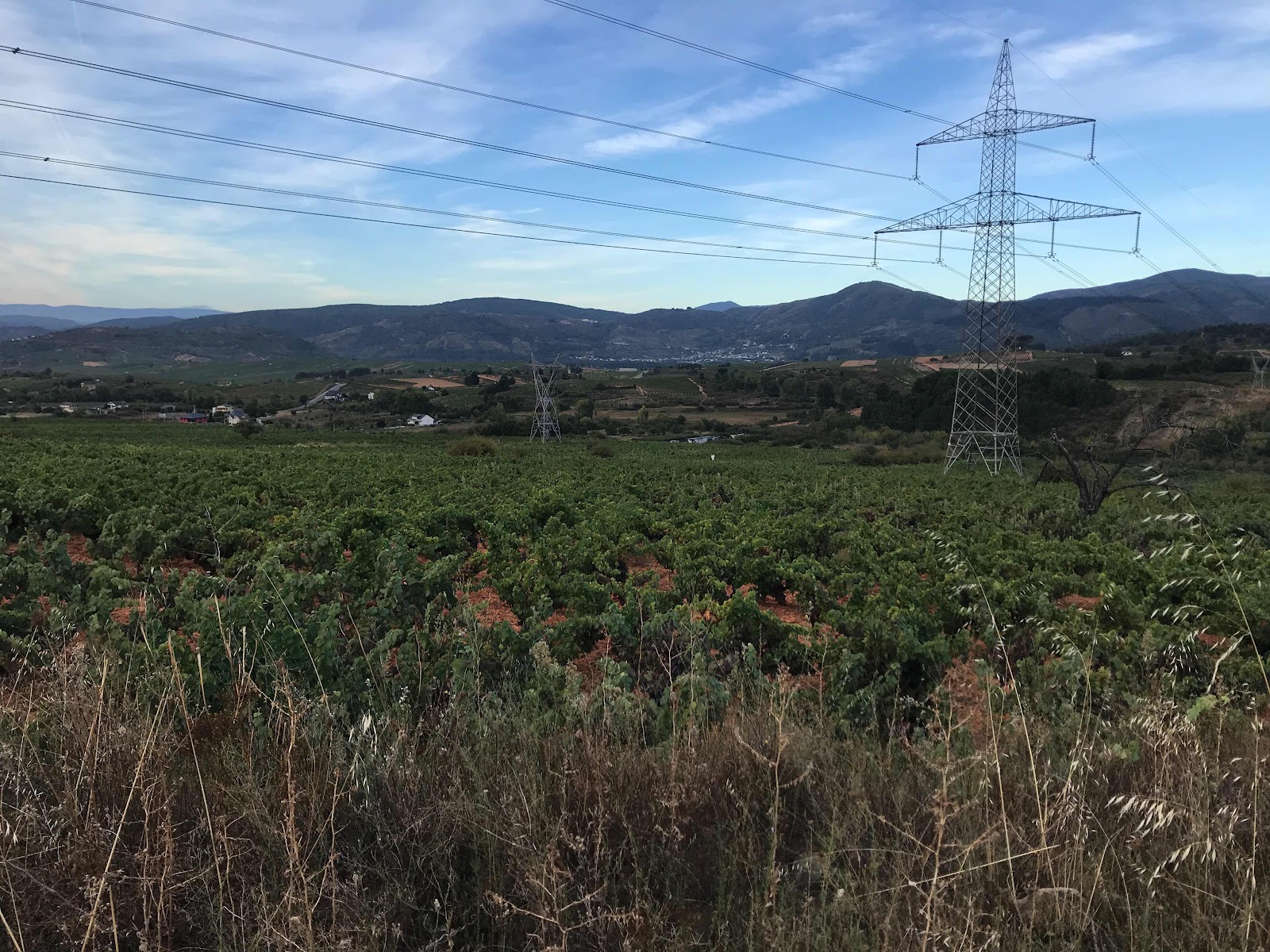
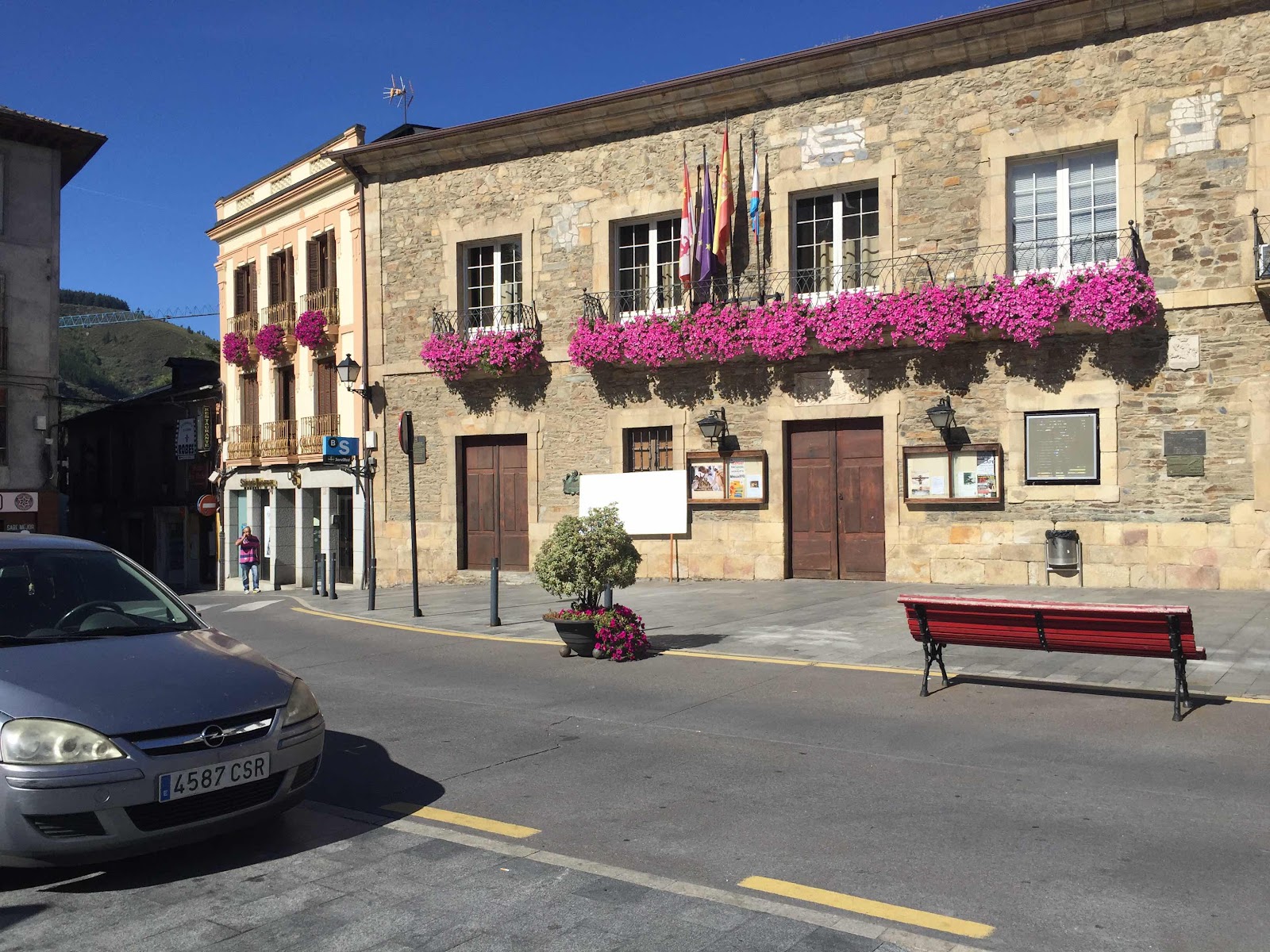
While looking in a church albergue, D’Anne caught up with us and we talked a bit, then she took off at her speed walking pace. For the next mile the way was the shoulder of a fairly busy road. Not enjoyable at all. Finally, it turned off into field of grapes. We followed narrow farm roads for the next 4 miles, stopping now and then to sample the grapes. They were ripe, sweet, juicy and delicious. The way undulated over low ridges and down into shallow valleys until we finally dropped into Villafranca del Bierzo. It had been six miles since the bread stop. We stopped at a corner cafe for a soda, put our feet up and were enjoying ourselves when Barry turned the corner. We spoke with him for 5-10 minutes, then dropped (literally) into downtown to the Plaza Mayor and found a restaurant to have lunch. We also bought a knock off brand of KT tape at a farmacia.

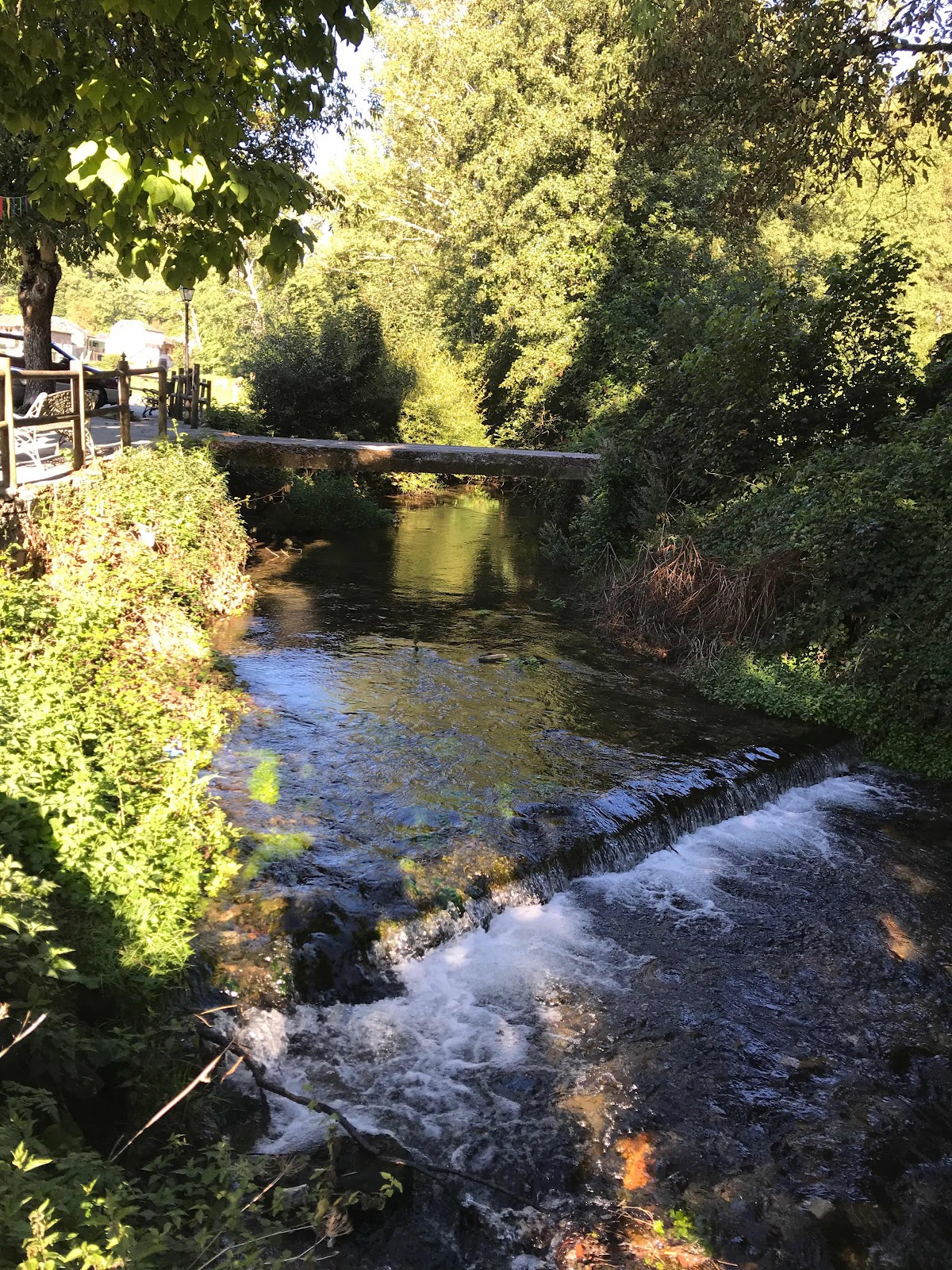
We walked through this beautiful town, circling around to the bridge across the river. Once we were across the bridge, we walked through a little part of town and then started walking up a quiet, winding road. We had two choices once we crossed the bridge, and we had chosen the road in the river valley over a 700’ climb to a ridge top, a run along the ridge and then a 500’ drop to our town Trabadejo.   All that climbing and descending seemed too much work. Yet, we were edgy about walking the road because we thought we would be paralleling the freeway all the way up the river. We were, but it turned out the freeway was so elevated above the old winding road it replaced that its noise was nearly unnoticeable. At places the freeway was well over 150’ above us, the only evidence of it were the giant pillars of concrete we walked near. The road walking was delightful. It hugged the river, was shady and green with the sound of the river babbling by. We had 6 miles of this to walk. It passed quickly.

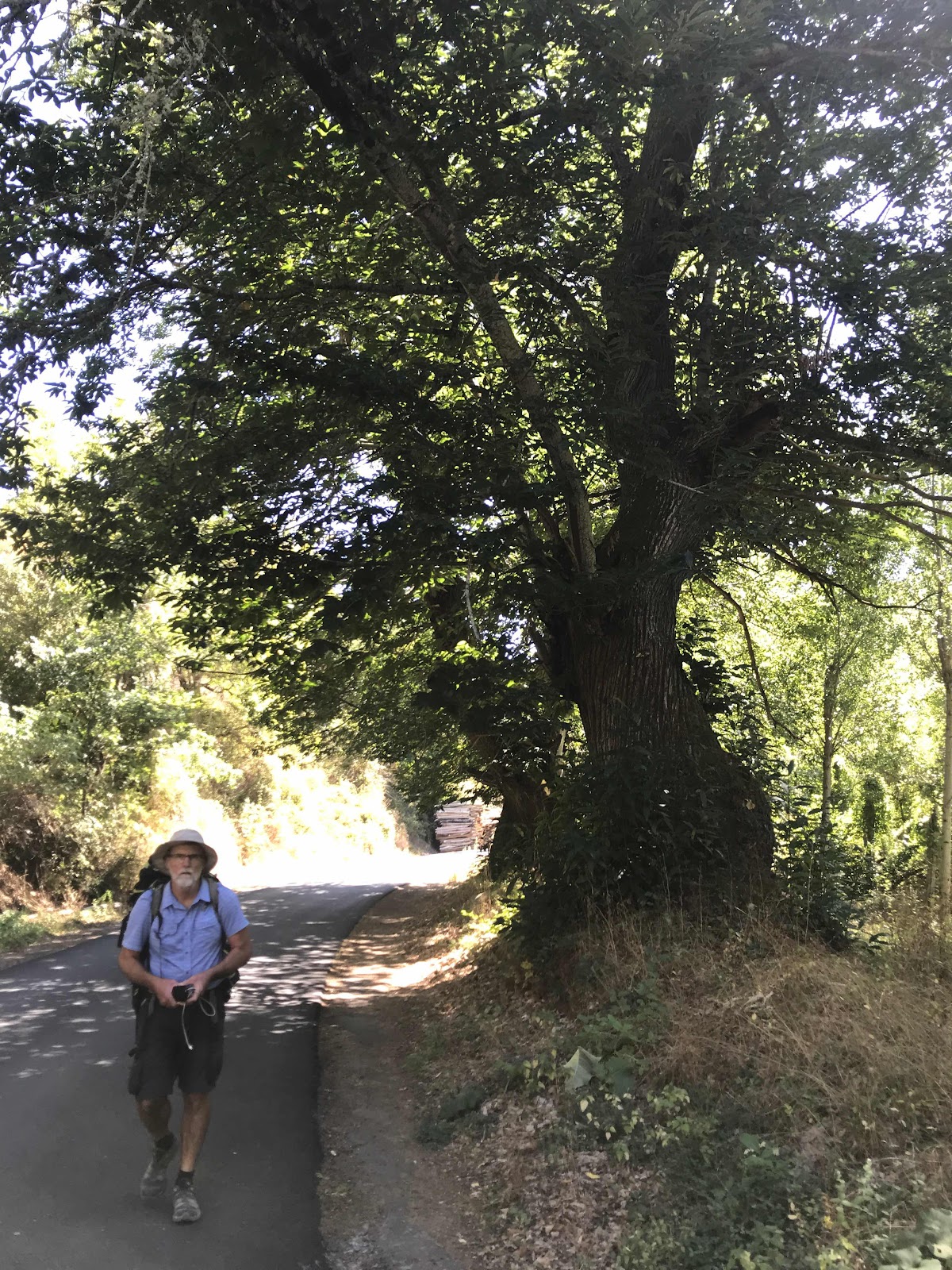
We entered the town of Trabadejo, walking past chestnut logs and chestnut lumber (the forests here are mostly huge chestnut trees), past the saw mill and stone buildings and arrived at Casa Susi, our albergue for the night. Fermin greeted us in the reception area and showed us the ins and outs. This building had been a pig barn for 300 years before Susi and her father repurposed it into a 12 bed albergue in 2017. They did a stunning job. Fermin and Susi grow vegetables in the back and then serve a communal style dinner for 9€ a head with the vegetables they have grown. We joined in, as did the other 10 guest. It was utterly fantastic!

D’Anne came by about 5:30pm with sodas and chips and we sat outside on the patio and talked. Jen from Germany joined us after awhile. We shared ideas and lives until 7:20 when we needed to go to our communal dinner.

As is usual, we each shared a bit about ourselves before dinner started, then Fermin brought out a tomato, zuchini, bread dish that was incredible. That out of the way we had a Spanish rice and vegetable dish that was equally amazing. Sorbet for dessert. Wow!

Between getting to the albergue later than normal (about 3:15) meeting D’Anne at 5:30 until 7:30 and then dinner from 7:30 to 9:30, we got nothing done. No planning, no writing, no packing, no pack pickup arrangements. But, we had a great time and will catchup tomorrow. We plan to only hike 8 miles tomorrow. This will give us time to make arrangements. We are about to enter the last 100 miles. Tour buses bring hordes of tourists in for this last part of the Camino and accommodations can be difficult to obtain by just walking into town, or so we hear. We are hoping to, and dreading, planning the next 8 days and making reservations. Dreading, because we like to be spontaneous when traveling on foot or by bike, but 2000 people a day finish in Santiago, so accommodations can be at a premium. We must plan ahead and then stick to our plan. Bummer. 


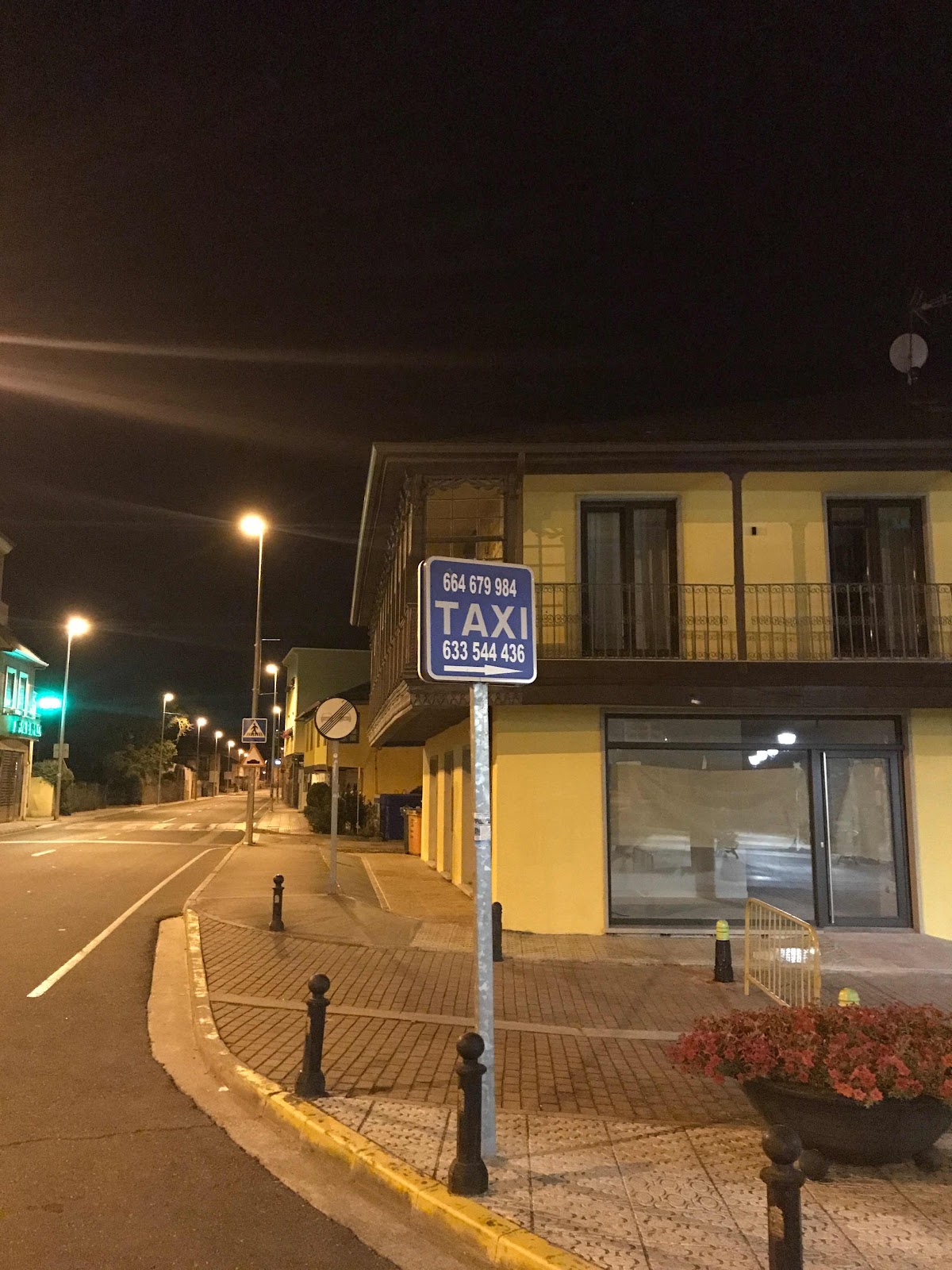
Town before sunrise. We took a photo of the taxi sign Incase we needed to call one to get us to our destination. 


Bread coming fresh out of the oven


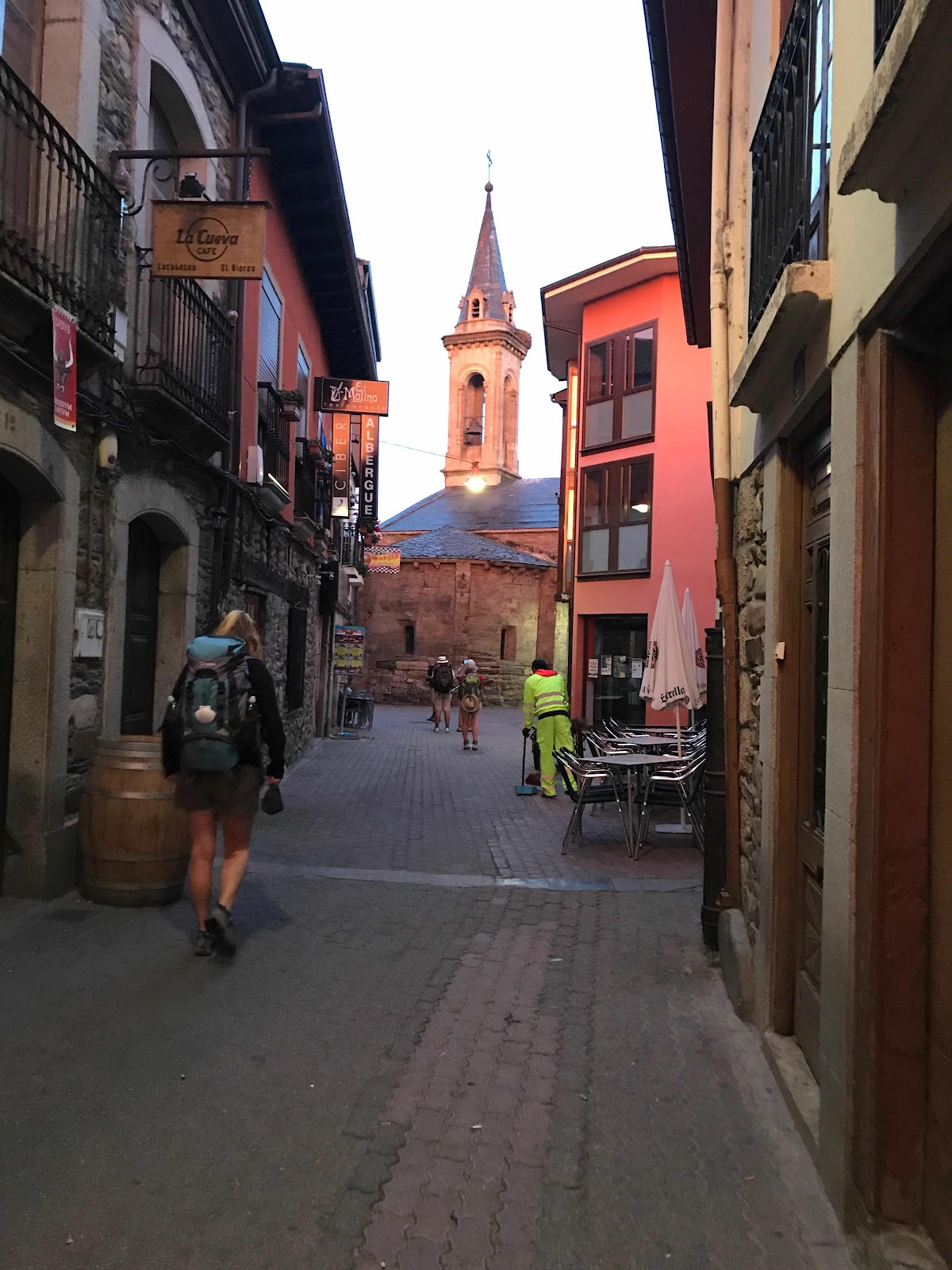
Sunrise on the steeple


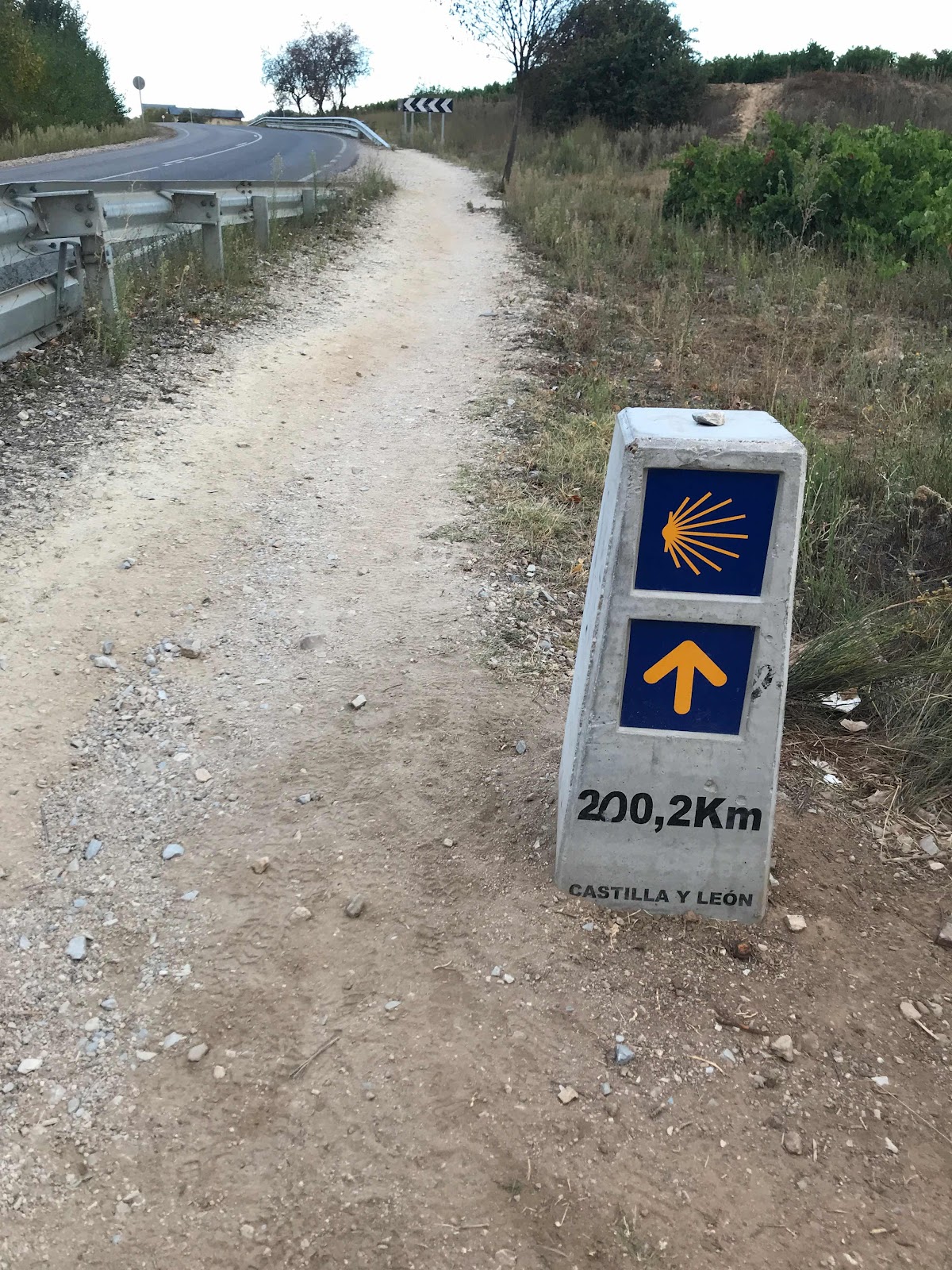
200 Km to go. 


Fields of grapes


Fields of grapes


Plaza Mayor in Villafranca


Entering Trabajo beneath the spreading chestnut tree


Red Chair - first one in town


Patio outside Casa Susi


The gang at communal dinner

Wednesday, September 11, 2019

Day 13 - Tuesday, September 10, 2019 - El Acebo to Camponaraya - The big descent - 15.56 miles - Total Miles to Date - 152.42


Can I spend a minute talking about time zones, daylight hours and daily temperatures? Thanks.

When flying over to Europe, I looked at the time zone distribution in Europe. Either I have forgotten or never taken notice before, but all of Europe is on the same time, from Vienna in the east to Spain in the west. Only Great Britain and Portugal are on their own time zone, more appropriate to their geographic location. If one looks at a time zone map with the vertical lines running through the countries one will see that Europe actually spans 3 time zones, yet they must have agreed to put all of the EU on the same time. This would be the same as if the US from Chicago to Seattle was all one time zone, 7:00am in Chicago is 7:00am in Seattle. This creates something remarkable. When the sun sets in Chicago at, say 7:00pm, it would still be two hours before sunset in Seattle. The sun would not set until 9:00pm. 

Here in Europe, the sun sets in Vienna at 7:15pm. In Spain, where we are west of Madrid, the sun sets at 8:43pm, an hour and a half later. Spain has sun late into the evening, Austria gets dark early. In Vienna, the sun rises at 6:25am. In Spain, it rises at 8:02am. Great for the hard working Austrians to get up early and get to work and go to bed early. Great for the fun loving Spanish to stay up late in the twilight and then sleep in until the sun comes up. 

The reason I bring this up is daily temperatures. We have had a week of nice cool temperatures, lows in the mid 40º, highs in the lower 70’s. The weather is changing now, with highs predicted in the upper 80’s coming. This means we want to be done hiking before noon to avoid walking in the sun in the heat of the day. Or you would think. . . .  Looking at the temperature predictions given by the hour, the high temperatures are not reached until late afternoon or early evening, like 4 to 6 o’clock.  Until I looked at the time zone situation, I could not understand how that could be. Now I see that 4 in the afternoon here should really be 2 in the afternoon. The time zone shifts everything about 2 hours later in western Spain. This means we can hike until 2 or 3 and not be hiking in the heat of the day.

To test this idea, at 2:00pm one day I took out my compass and found due south.  The sun should have been 30º to the west of due south at 2:00pm. The sun was exactly due south-the definition of 12:00 noon. Everything here is shifted 2 hours later.  Thanks for indulging me in my time zone ramblings. 

We got up at 5:00am, snuck out of our room and got prepared to walk, me in the men’s bathroom, Sally in the women’s. We met in the lobby, made final preparations and walked out the door about 5:55am. We had about 5 miles of downhill before us. The Camino parallels the road. We chose to walk the road rather than the trail for a couple reasons. In the dark, footing is much more sure on the road and the road is less steep and therefore easier on Sally’s knees. At this time in the morning the road was deserted and we only encountered about 5 or 6 cars in the two hours we were on the road. 

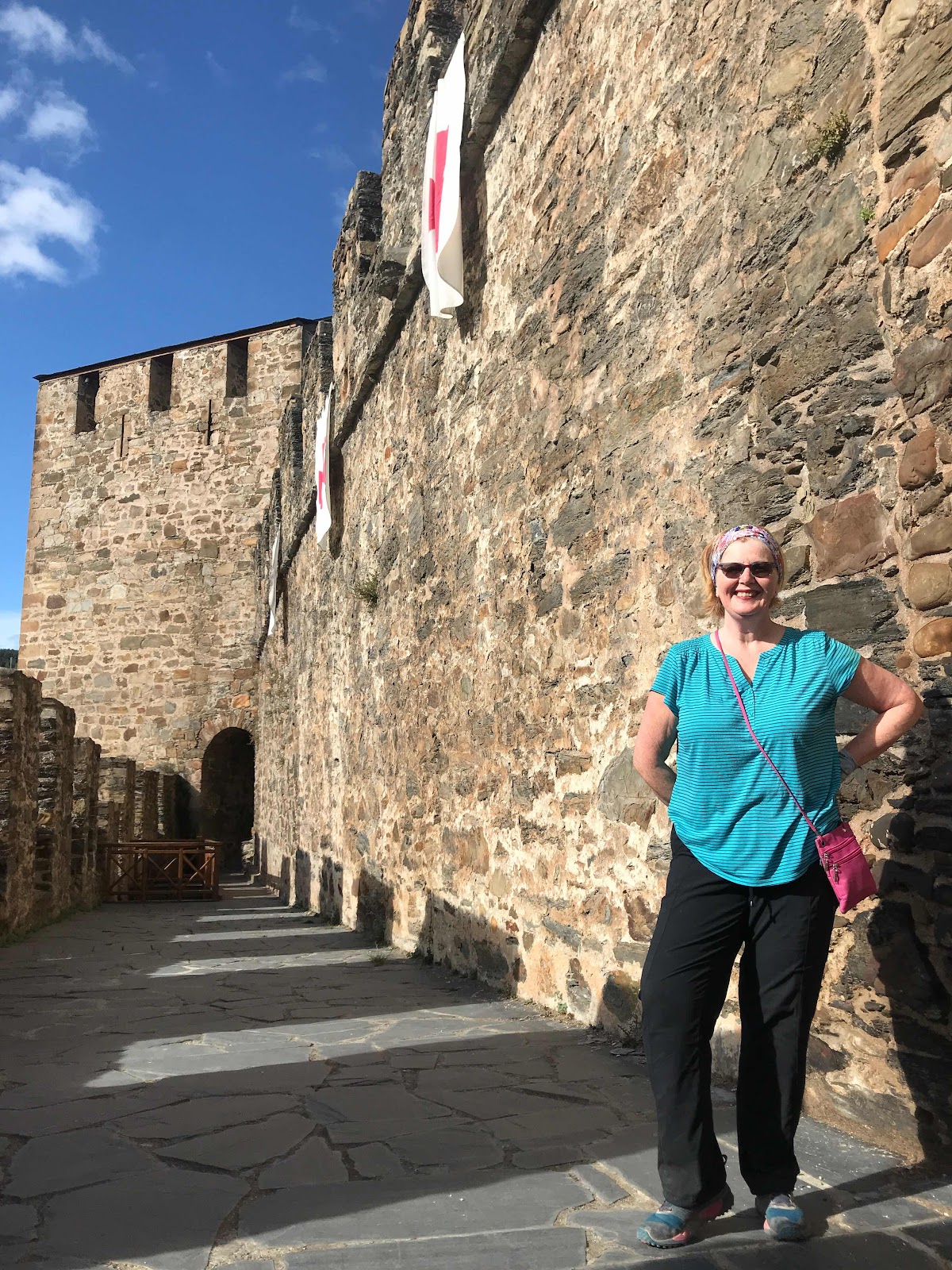
At the bottom of the hill lies the town of Moleneseca, a beautiful, quaint town. We stopped at the first red chair we saw and enjoyed a break. We had completed a little more than 5 miles in under 2 hours. Here we met Karen and Kelly, two sisters from England. On the road again, we were walking out of town next to a highway. Eventually, the way got on less traveled roads. Our immediate destination was the Knights Templar castle in Ponferrada, about 5 miles away. We got there about 10:30, paid our 8 euro and toured the castle. It was fun to see true castle, ramparts, turrets and all. 

Back on the way we bypassed old town (a mistake) and ended up downtown hungry and a few blocks from any food. Downtown had a lot of tagging and was dirty and gritty. With the help of some locals we found a grocery store and a bakery, got something to eat and returned to the way. 

There were three towns that begin with a C and we stayed in the second one, Camponaraya in the Medina albergue. It was wonderful. Here we met Barry from San Luis Obispo and Jen from Germany. Jen is about 31 and very knowledgeable. Barry walked into the bar while Sally and I we having a beer and a Coke and a bag of chips. He joined us, then we moved to the dining room and had dinner together. He has four daughters, is 67 and a very kind and engaging man. He is now a hedge fund manager, and formerly a college professor. 

We made it back up to our beds about 9:30pm. In a room with 10 bunk beds (20) beds) we only had 7 of us. Quiet and comfortable . . . zonk. 


Streets of Molinaseca 


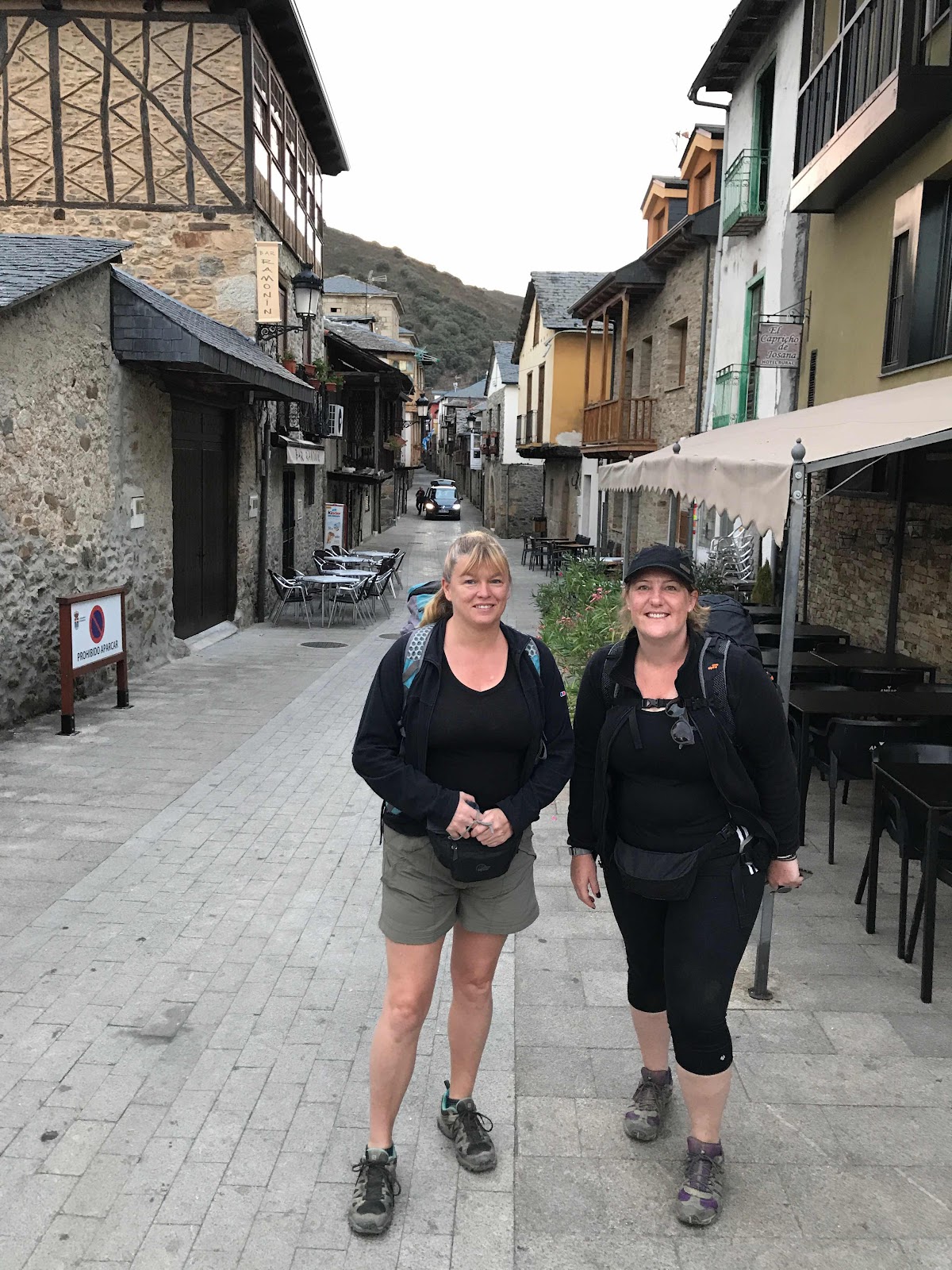
Karen and Kelly


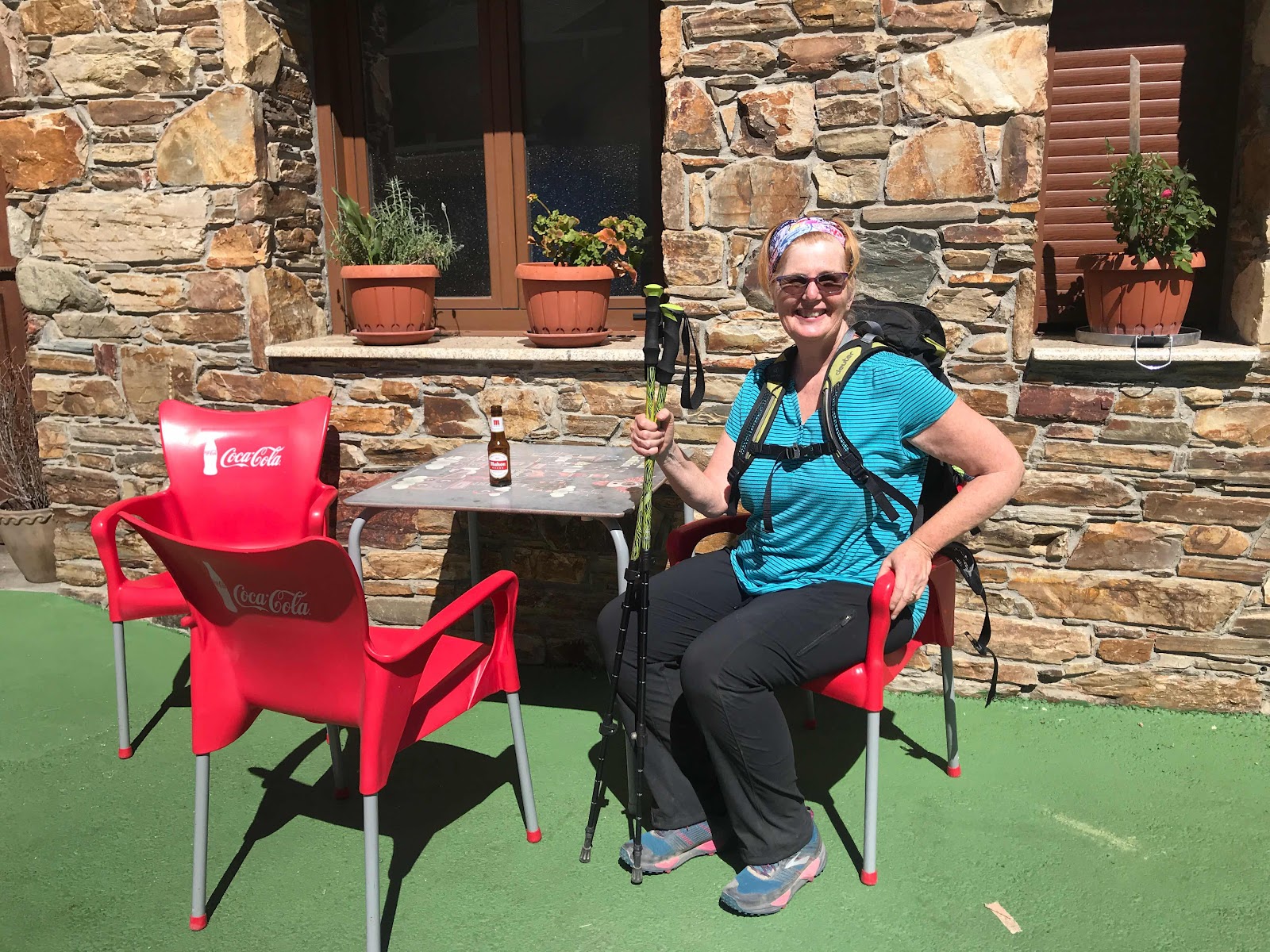
Red chairs come in all sorts of colors


Knights Templar castle


Creative signposts show the way


Many of the small towns are nearly 100% abandoned. Cool old buildings in need of love and money.